· Dana Whitfield
How to use a snake hook without stressing the animal
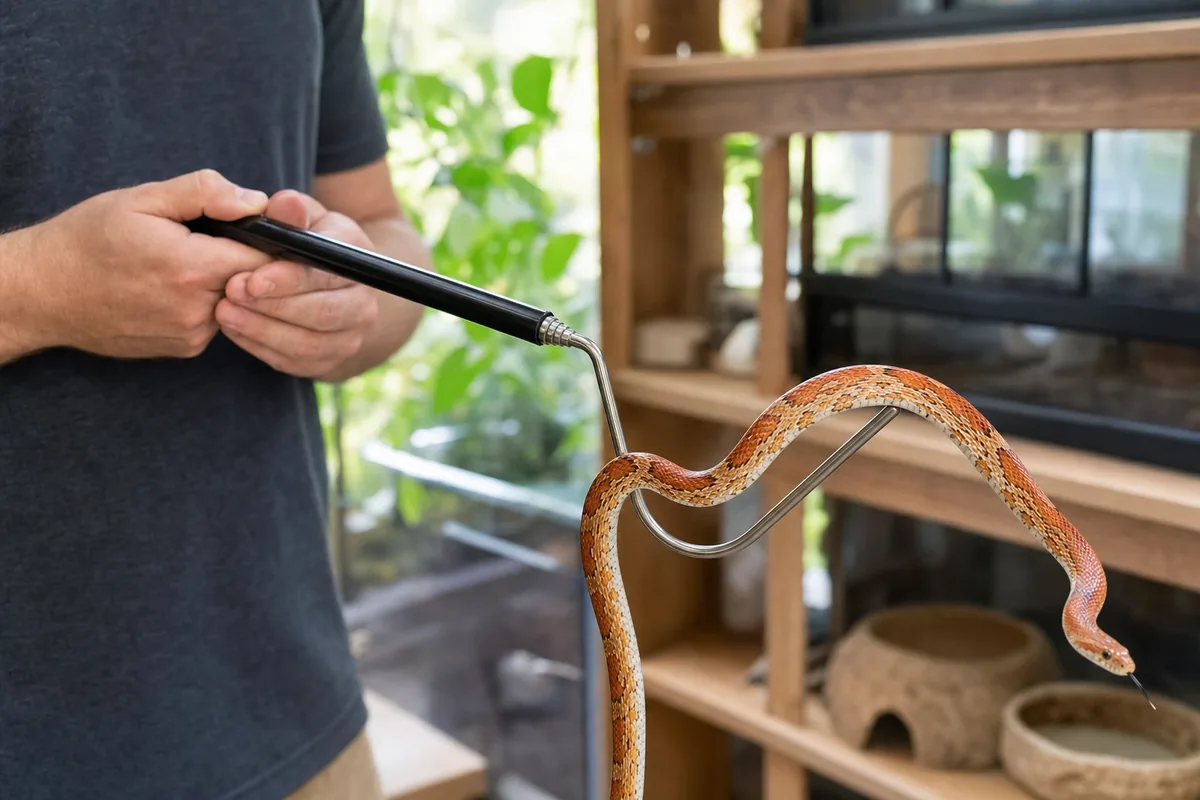
A snake hook looks like a tool that needs no instructions. It is a shaft with a bend on the end, and the first time you use one it will probably work well enough. The gap between well enough and good shows up later, in the animals that learn to expect the tool and calm down when they feel it, and in the ones that never settle because every session started badly. The technique below is what separates those two outcomes. None of it is complicated, and all of it can be practiced in one afternoon on an empty tub before it is used on a live animal.
Step one: hook training, before the door opens
The most useful thing a hook does happens before it touches the snake at all. A ball python that has learned the enclosure door means dinner will treat the first warm object through it as dinner. Tapping the substrate two or three times with the shaft, then waiting five or ten seconds, gives the animal a signal that this is a different kind of event. Keepers call it hook training, and it works because snakes read vibration far more reliably than they read anything visual.
Do it identically every time. Same number of taps, same corner of the enclosure, same pause afterward. Consistency is what turns a random vibration into information the animal can act on. Species with a strong feeding response, which in practice means ball pythons, boas and anything that has been fed inside its enclosure for years, tend to pick this up within a few weeks. Colubrids that were never food focused rarely need it, but the habit costs nothing and it keeps your routine identical across a whole collection.
After the taps, the hook goes in before your hand does. This is the part that beginners skip and experienced keepers never do. The shaft finds out whether the snake is behind the hide, coiled at the front, or already in strike posture, and it finds out from a distance instead of with your fingers. On our main hook page we describe this as opening the door with the tool rather than with your body, and it is the single habit that prevents the most bites in normal keeping.
Step two: the lift, from the middle third
Come in under the middle third of the body. Not the neck, not the tail, the middle. From there the snake balances across the bar and can adjust its own weight distribution, which is exactly what it does in a branch in the wild. Hooked near the head, an animal feels restrained and turns to face the source. Hooked near the tail, it hangs, panics, and whips toward the other end of the shaft looking for purchase.
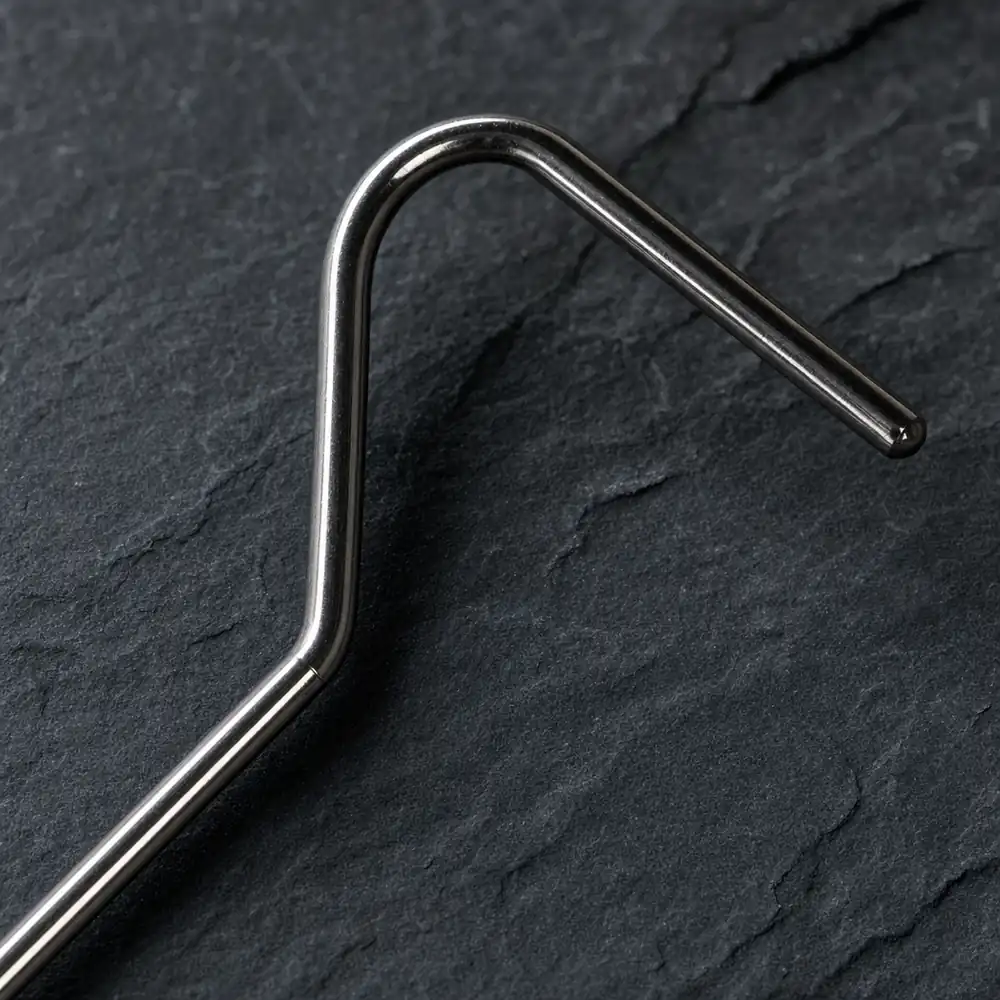
Slide the head under the body rather than scooping upward at it. A smooth lateral entry moves substrate out of the way and lets the snake feel the bar arrive gradually. A fast scoop lifts bedding, catches the animal off balance and usually ends with it pouring straight off the side. The bend on this hook measures roughly 1.8 by 2 by 2.2 in (4.5 by 5 by 5.5 cm), which is wide enough for a body to rest across and shallow enough that nothing gets trapped in the curve.
Then lift slowly and stop. Give the snake two or three full seconds on the bar before you move anywhere. Almost every animal stops moving once it registers that the surface underneath it is stable, and the ones that keep moving are telling you they were not balanced properly in the first place. Lower the hook, reposition, and try again. There is no cost to a second attempt and there is a real cost to a drop.
If the snake is long enough that both ends hang well past the bar, support it with a second point of contact. That can be your free hand under the front third for a calm animal you already handle, or a second hook for one you do not. Two contact points spread the load and make the whole lift feel like a branch instead of a wire.
Step three: the move and the transfer to a tub
Have the destination open and ready before you lift. A tub with the lid already off, placed on a surface at roughly the same height as the enclosure, turns the transfer into a short horizontal move instead of a long carry with a free hand fumbling for a latch. Most drops happen during the part of the job that had nothing to do with the snake.
Move in one steady pass. Walking with a hooked snake, turning, and stopping halfway all give the animal reasons to start searching for something better to hold onto. Keep the hook low, roughly at waist height, so an animal that does leave the bar has a short fall onto a soft surface rather than a long one onto tile.
To set the snake down, lower the hook to the floor of the tub and tilt the head slightly so the body slides off on its own. Do not shake the shaft and do not pull the hook out from under a snake that has decided to grip it. Snakes let go of things that stop being useful within a few seconds. Waiting is faster than forcing, every time.
What never to do with a hook
Never hook near the head or the tail. Both create the same problem from opposite ends, which is an animal carrying its own weight on a narrow point of contact rather than resting on a supported middle.
Never drag a snake across a surface with the hook. Dragging scrapes ventral scales against substrate, glass edges and rack lips, and it teaches the animal that the tool means being pulled somewhere it did not want to go. A hook is a lifting and steering tool, not a rake.
Never force a grip. If the snake has anchored itself around a branch, a hide or the shaft itself, the hook has finished doing its job. Prying at an anchored constrictor is how ribs get bruised and how keepers end up with a bite that had nothing to do with feeding response. Wait, or switch tools. Our hook and tongs comparison covers where that line falls in practice.
And never treat a hook as a licence to handle species you are not trained for. The Centers for Disease Control and Prevention reports 7,000 to 8,000 venomous snakebites in the United States each year, with about 5 deaths (CDC, 2024). More telling for anyone holding a tool: 32.1% of media reported US snakebites resulted from purposefully handling the snake rather than from an unseen encounter, according to Curry, Bond, Kunkel and colleagues in Wilderness and Environmental Medicine (2016). A hook adds two feet of distance. It does not add training, and it is not a substitute for calling a professional when a venomous animal turns up where it should not be. The catching guide covers that scenario in more detail.
The mistakes beginners make most
Reaching in with a hand first, because the hook is leaning against the wall on the other side of the room. Keep the tool with the animals, not with your tools. This one collapses to about 7 in (18 cm), which is small enough to live on top of the rack.
Extending the shaft to full length for every job. A 26 in (66 cm) hook inside a small enclosure is unwieldy and bangs into the glass. Set the length to the enclosure, not to the maximum. Six telescoping sections exist so you can pick a length in between.
Hooking too fast because the snake is moving. A moving snake is not an emergency. Let it settle, or let it move to a spot where the middle third is accessible, then come in. Chasing an animal around a tub with a hook produces exactly the stress response you bought the tool to avoid.
Using a compact hook on an animal it was never built for. This one handles hatchlings, juveniles, corn snakes, kingsnakes, milk snakes and ball pythons up to roughly a year old. One verified buyer summed it up as good for python hatchlings up to a year old, and that matches our own testing. For an adult boa or a retic, use a full size hook and a second person. The size ladder on the product page draws the line explicitly, and the how we test page explains where those limits came from.
Practicing on an animal instead of on nothing. Before your first real lift, spend ten minutes lifting a coiled rope or a length of garden hose off a towel. It feels ridiculous and it teaches the wrist angle faster than three months of real sessions, and it is the same test we recommend to anyone finishing a homemade hook. You can read what other keepers reported on the reviews page, or work through the rest of the handling guides on the blog index once the basics feel automatic. If your collection has outgrown a compact hook, the folding tongs cover the jobs it cannot.