· Dana Whitfield
Snake hook for ball pythons: hook training that sticks
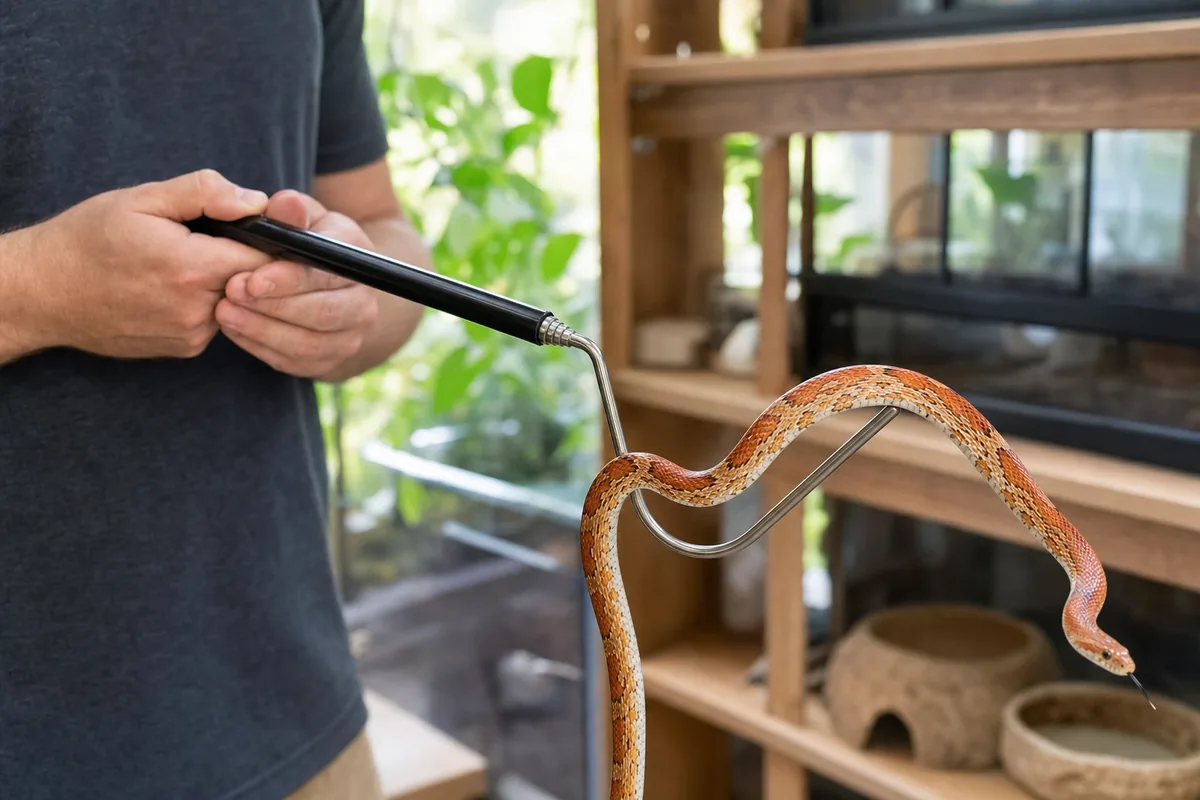
Ball pythons are the species that turns most keepers into hook users, and it usually happens on a Wednesday evening during feeding week. The animal has been placid for months. The door slides open, a warm hand comes through, and a snake that has never shown a hint of temper launches at it. Nobody gets hurt, because a ball python bite is a scratch and a bruised ego, but the trust goes sideways for a while and the keeper starts dreading the enclosure. A twenty-five dollar telescopic hook fixes almost all of that, provided you understand what it is doing.
Why a ball python strikes the hand and not the hook
Ball pythons hunt with heat. The labial pits along the upper jaw read infrared, and during the days around a scheduled meal that sense is running at full attention. A human hand at roughly 90 degrees Fahrenheit entering a warm dark box is, from the snake's side of the glass, indistinguishable from a rat arriving. The strike that follows is not aggression and it is not a personality problem. It is a feeding response, and it is the animal doing exactly what it evolved to do.
A stainless shaft gives that system nothing to work with. It sits at room temperature, it has no pulse, it does not smell like prey, and it does not close around the animal. The snake investigates it, decides it is a branch, and either ignores it or climbs onto it. That is the whole mechanism. You are not disciplining a snake or asserting anything over it, you are simply presenting an object its senses have no reason to attack.
The second half of the effect is about association. A snake that only ever meets a hand at the moment it gets lifted out of its home learns that hands mean an unwanted event. A snake that meets a cool bar first, gets moved, and only then rests on a warm hand once it is out and calm, learns to file the two experiences separately. Keepers with racks full of animals build their routine around that distinction, and it is the single reason hooks outsell every other handling tool in the hobby.
Hook training, one session at a time
Hook training is a small ritual repeated until it becomes a signal. The version most keepers converge on has three parts, and it takes about ten seconds.
Tap first. Open the enclosure, reach in with the hook only, and touch the shaft gently to the substrate or to the side of the hide two or three times. That sound and vibration are your announcement. Nothing else in the snake's world makes that noise, so it becomes a clean cue rather than one more ambiguous disturbance.
Touch the body, not the head. Rest the curved head lightly against the middle of the snake for a second before you lift anything. A ball python in feeding mode will often tighten into an S at this point, and that is your information: today is not the day. Close the door, come back tomorrow. A snake that flattens out or starts moving normally is telling you it has switched out of hunting mode.
Lift from the middle third. Slide the head under the body about halfway along and raise it slowly. From the middle the animal balances and can redistribute its own weight. Lift near the neck or the tail and it hangs, panics, and starts whipping toward the other end of the bar. Give it two or three seconds in the air before you move anywhere, because most snakes stop searching for the ground once they decide the bar is not going to move.
Done four or five times a week for a month, the tap alone becomes enough. The snake hears it, uncoils, and waits. Our step by step technique guide covers the same sequence in more detail, including what to do when the animal will not come off the hook.
What size hook a ball python actually needs
This is where most buying advice goes vague, so here is the specific version. A hatchling ball python at eight weeks weighs almost nothing and lives in a small tub. What it needs is a short shaft with a small bend, because a 40 in professional hook in a shoebox tub is a comedy of missed angles. A yearling in a 4 ft enclosure needs reach, which means something that extends. An adult female at five years is a different proposition entirely, and pretending otherwise is how people end up dropping snakes.
| Stage | Setting on this hook | Notes |
|---|---|---|
| Hatchling, tub housed | Collapsed to about 7 in | Short shaft, full control, no wasted length |
| Juvenile, first year | Anywhere from 12 to 26 in | The range this hook was built for |
| Around a year old | Full 26 in extension | The documented limit, confirmed by a buyer |
| Adult, past a year | Not the right tool | Move to a full size fixed hook |
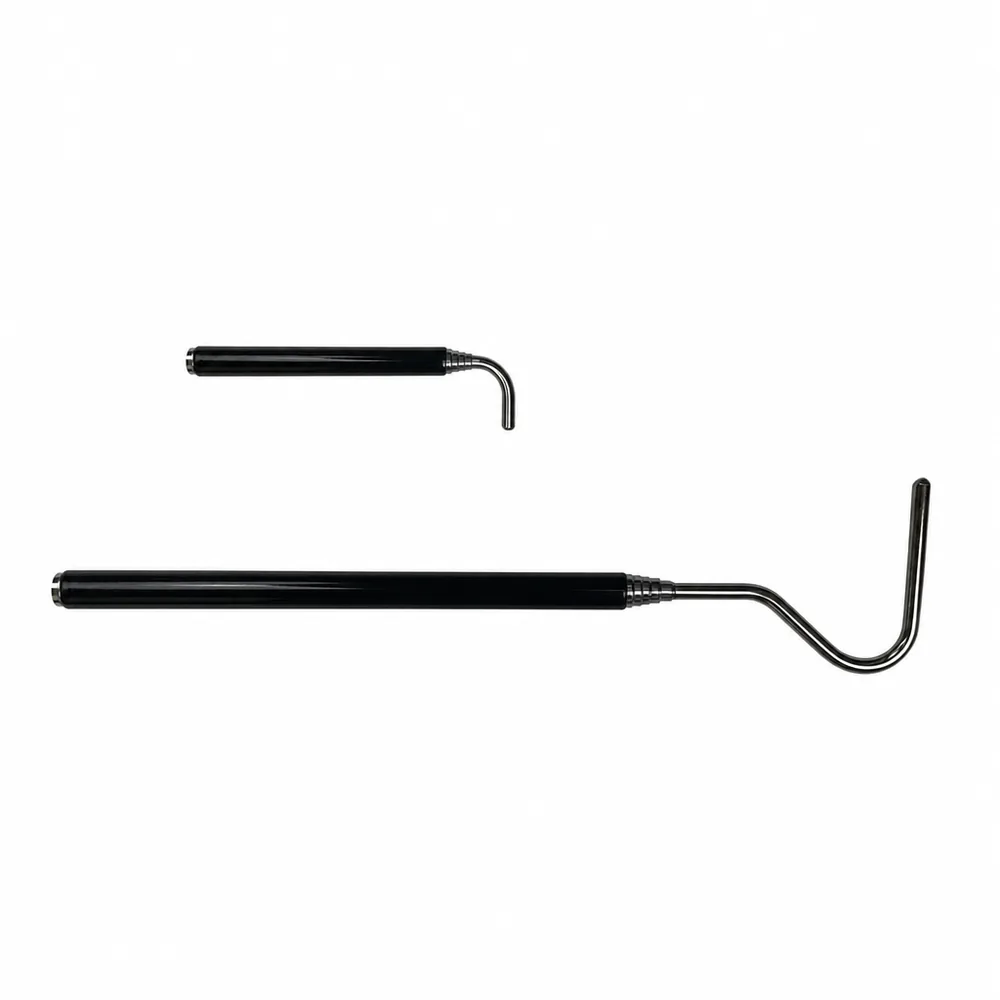
We publish that ceiling rather than hiding it. The Herpaxe hook is stainless steel through six telescoping sections, running from 7 in (18 cm) collapsed to 26 in (66 cm) extended, with a curved head measuring roughly 1.8 by 2 by 2.2 in (4.5 by 5 by 5.5 cm). Those numbers describe a compact tool for small and mid size snakes. One of our verified buyers put the limit more plainly than our own copy did: good for python hatchlings up to a year old. We left that review up and wrote the sizing table around it. The rest of the ratings are on the reviews page, and our testing process is documented on how we test.
The out of enclosure routine, start to finish
A calm handling session has a shape, and following it is most of what separates a snake that tolerates being moved from one that dreads it. Start with the room, not the animal. Close the door, move the dog out, put the phone face down. Have the destination ready before you open anything, whether that is a weighing tub, a cleaning bin or a second enclosure, because a snake held in one hand while you hunt for a lid is a snake that gets dropped.
Then run the sequence. Tap, touch, lift from the middle, pause. Bring the hook out of the enclosure with the snake balanced across it and let it move onto your forearm in its own time rather than peeling it off. Keep sessions short at first, five minutes is plenty, and end while the animal is still relaxed instead of waiting for it to get squirmy. Put it back the same way it came out, hook first, and resist the urge to drop it in from height.
Two things end a session immediately in my collection. A snake in a tight S with its head pulled back gets left alone, and so does one that has just eaten. Ball pythons digest slowly and handling a snake with a meal in it is how you get a regurgitation, which is genuinely dangerous for the animal in a way that a missed handling session never is.
Where this hook stops, and what to do next
Past about a year, a ball python outgrows a compact telescopic shaft. The animal gets heavy enough that a thin bar concentrates its weight on one point rather than spreading it, and the reach stops being enough for a bigger enclosure. At that stage you want a full size fixed hook, and if you keep adult boas or larger pythons you want a second person as well. Buying a heavier hook is not an admission that the small one failed, it is the same progression every keeper goes through as their animals grow.
Price is worth a sentence here, because the assumption that serious equals expensive costs people money. A professional-tier titanium snake hook lists at $69.95 (professional-tier retail listing, 2026). That tier is built for handlers working large or dangerous animals daily. It is also close to three times the price of what a first year ball python needs, and a hatchling cannot tell the difference between titanium and stainless steel.
The other tool people ask about is tongs. Tongs grip, hooks support, and for routine enclosure work with a ball python the hook is the one you want, every time. Tongs earn their place when a snake has to be extracted from somewhere a hook cannot reach, which in practice means outside the collection rather than inside it. The full comparison lays out where each one wins, the tongs page has the specifications, and if you are heading out to look for wild snakes rather than keeping them, start with the field gear checklist instead. For anything that turns up uninvited in a house or a yard, read the catching guide first and never improvise with a venomous animal.