Snake Catcher: What To Do First, And Which Tool Comes After
If a snake has turned up at your house, the first decision is not which tool to buy. It is whether this is a job for you at all. This page answers that question before it sells you anything.
Written by Dana Whitfield, reptile keeper. Updated for the 2026 season.
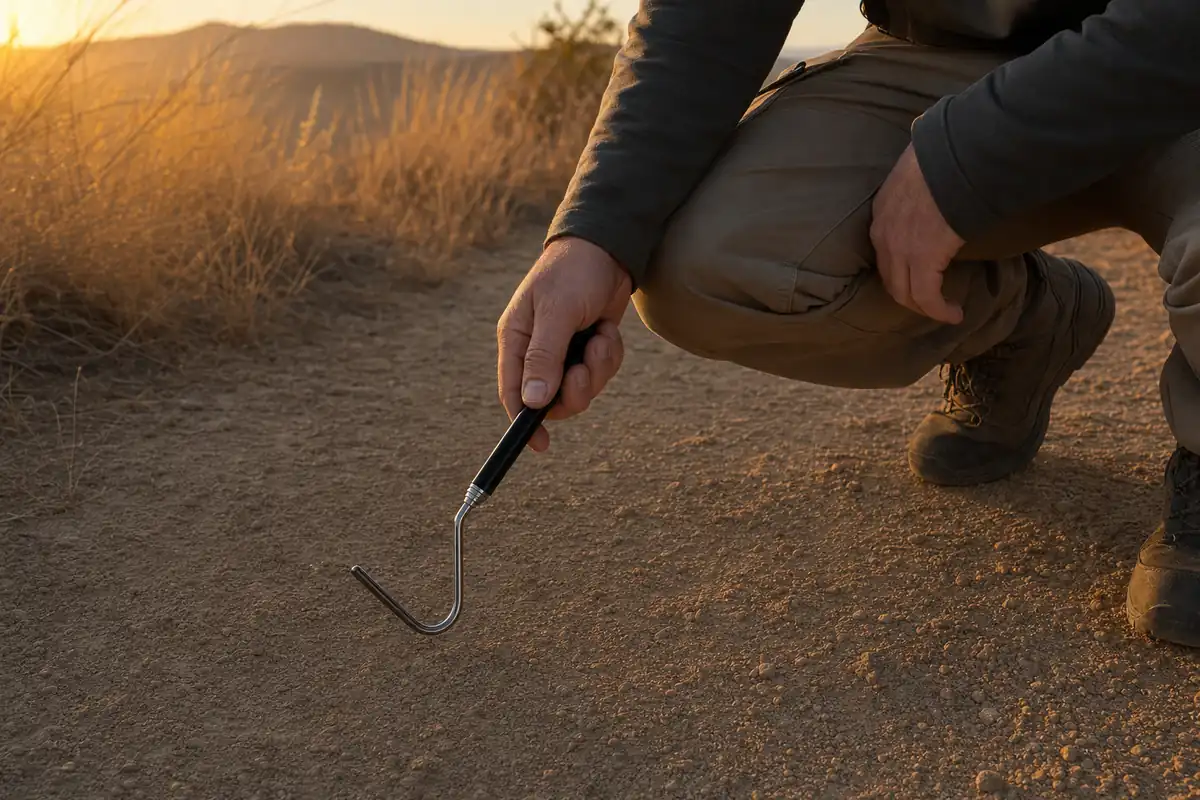
What a snake catcher is, and when you should be one
That order matters more than anything else on this page. Search results for snake catcher tools are full of products and almost empty of judgment, which leaves a homeowner with a snake in the garage deciding between two-day shipping and a broom. Neither of those is the right answer at eight in the evening with an unidentified animal behind the water heater.
We sell handling tools, and this page opens with the call that comes first: a snake you cannot identify is a job for animal control. Our hook and tongs are built for the snakes you keep on purpose. The numbers below are the reason.
Why the first decision is a safety decision
venomous snakebites reported in the United States each year, with about 5 deaths
— Centers for Disease Control and Prevention, 2024
of media-reported US snakebites came from purposefully handling the snake rather than an unseen encounter
— Curry et al., Wilderness and Environmental Medicine, 2016
list price of a professional-tier titanium snake hook, for comparison with what a removal call costs
— Professional-tier retail listing, 2026
Read those first two together and the picture is clear. Bites are not rare, deaths from them are, and roughly a third of the reported cases came from someone choosing to pick the animal up. That last figure is the one this page exists to reduce. Nobody in that third of cases woke up planning to get bitten. They saw a snake, decided it was probably fine, and reached.
Only 32.1% of bites were deemed illegitimate bites that resulted from the purposeful handling of the snake.Curry, Bond, Kunkel et al., "An Analysis of Media-Reported Venomous Snakebites in the United States, 2011-2013", Wilderness and Environmental Medicine, 2016
The practical translation is short. No length of shaft makes a venomous snake safe to handle, and nothing sold on this site is rated for one. Venomous removal is a trained, often licensed discipline, and it is the job of the person you call rather than the job of the box that arrives in eight business days.
The handling setup we would put in a garage
For keepers and for anyone who ends up moving harmless snakes off a property more than once a year, the hook is the everyday tool and the tongs are the one that saves the awkward calls. The bundle is priced below the pair bought separately.
There is a snake at your house: what to do
Every removal guide starts with technique. Almost none of them start with the question that actually determines the outcome, which is whether you should be involved at all. Below is the decision written as a table, in the order the questions come up in real life. Work down the rows and stop at the first one that matches your situation.
| Your situation | Do this | Do not do this |
|---|---|---|
| You cannot identify the species with certainty | Photograph from a distance, call animal control or a licensed removal service | Get closer for a better look |
| It might be venomous, or you live where venomous species are common | Clear the room, close the door, call a professional | Buy a tool and improvise tonight |
| The snake is inside a bedroom, kitchen or living area | Isolate the room, call for removal | Chase it into furniture where nobody can see it |
| Children or pets are in the area | Move them out first, then call | Attempt anything while the room is busy |
| The snake is injured, or a pet has already reached it | Call a wildlife rehabilitator or a vet as well as removal | Handle an injured animal by hand |
| Clearly a harmless local species, outdoors or in a garage, nobody at risk | Open an exit route and let it leave on its own | Rush it into a corner |
| Same as above, but it has to be moved now | Use a hook or tongs, move it to a bin with a lid, release it nearby | Pick it up with your hands |
| Any snake, any species, and you feel rushed or unsure | Stop and call | Push through the doubt |
Two details people ask about. Release the animal close to where you found it rather than driving it somewhere scenic, because a snake dropped in unfamiliar territory usually does badly. And if you are in any doubt about which row you are on, you are on the row that says call.
Why you should not trust the identification shortcuts
Almost everyone has heard the rules. Triangular head means venomous. Slit pupils mean venomous. Round pupils mean safe. Every one of those has enough exceptions in North America that a wildlife professional will not use them alone, and several harmless species flatten their heads into a triangle when they are frightened, which produces exactly the signal the rule tells you to fear.
What works instead is photography and a second opinion. Take a photo from several feet away, including the whole animal if you can, and send it to your state wildlife agency, a local herpetological society or a university extension office. Most of them answer identification requests, many of them answer quickly, and the answer costs nothing. Until it arrives, act as though the animal is venomous. That single habit removes most of the risk described in the statistics above.
There is a second reason to identify before acting, and it is not about your safety. Several North American snake species are protected, and killing one can carry a fine in a number of states. The species people most often mistake for a threat are rat snakes and garter snakes, both of which spend their days eating the rodents that brought them to your property. Removal, not elimination, is almost always the right outcome.
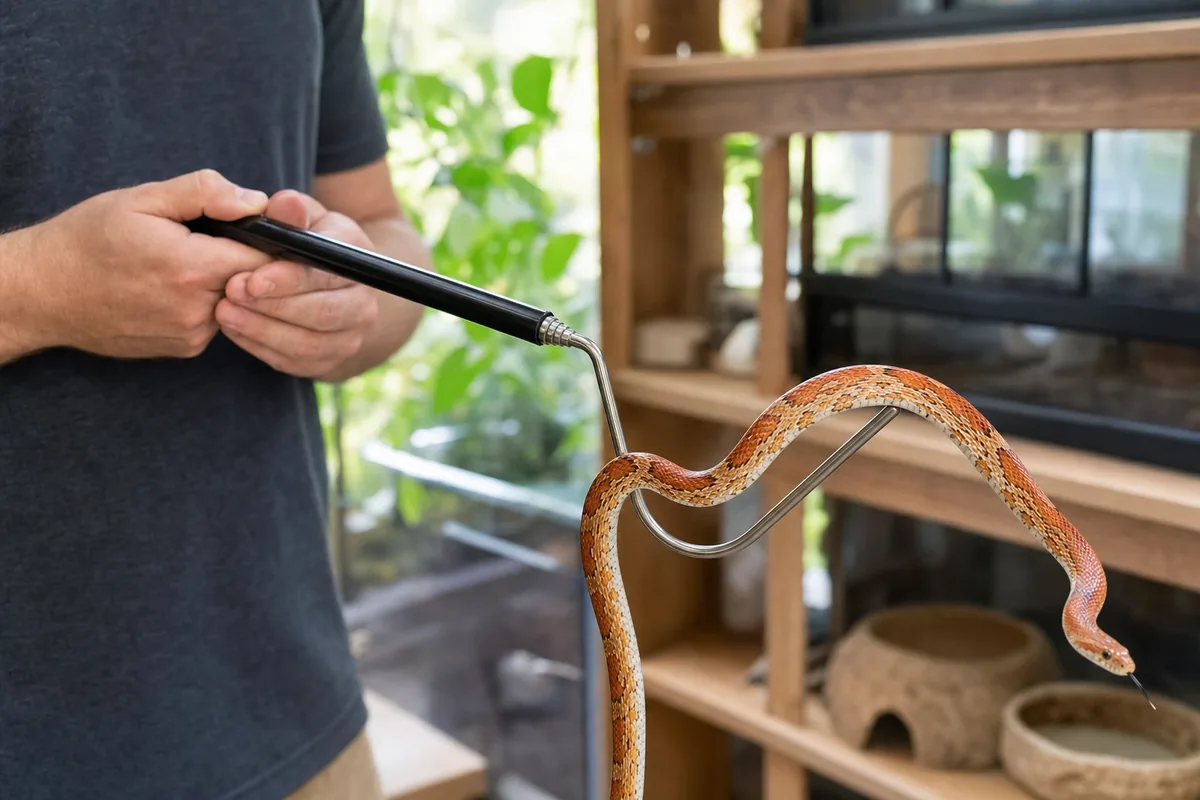
Moving a harmless snake, step by step
This section assumes every condition from the table above is met. The species is identified and harmless, nobody else is in the room, the animal is outdoors or in a garage, and you are not in a hurry. If any of that is untrue, go back and call.
Set up before you approach. Put a plastic bin with a locking lid on the ground within a few steps of the snake, lid off. Turn a flashlight on if the light is poor, because reaching toward something you cannot see clearly is how the whole thing goes wrong. Wear closed shoes and long pants.
Give it a route out first. If an open door leads outside, that is the easiest removal available. Stand back, stay quiet, and give the animal several minutes. A surprising share of garage and shed calls end here with nobody touching anything.
If it has to be moved, approach from the side. Slide the hook under the middle third of the body and lift slowly, letting the snake balance across the bar. From the middle it can adjust its own weight. From the head or the tail it hangs, panics and whips. If the snake is wedged somewhere with no clearance underneath, that is where tongs replace the hook, closed only as far as it takes to stop the snake sliding out.
Lower it into the bin and close the lid. Do not carry an animal any further than you have to. Once the lid is on, walk to a release point in the same yard or the nearest natural cover, set the bin down, open it, and step back.
Then deal with the reason it came. Snakes follow food and shelter. Rodent control, sealing gaps around pipes and under doors, moving woodpiles away from the foundation, cutting back tall grass and fixing standing water do more to keep them away than anything sold as a repellent. Our garage removal walkthrough goes through the whole sequence with the exclusion work included.
What snake catcher poles, sticks and tongs actually are
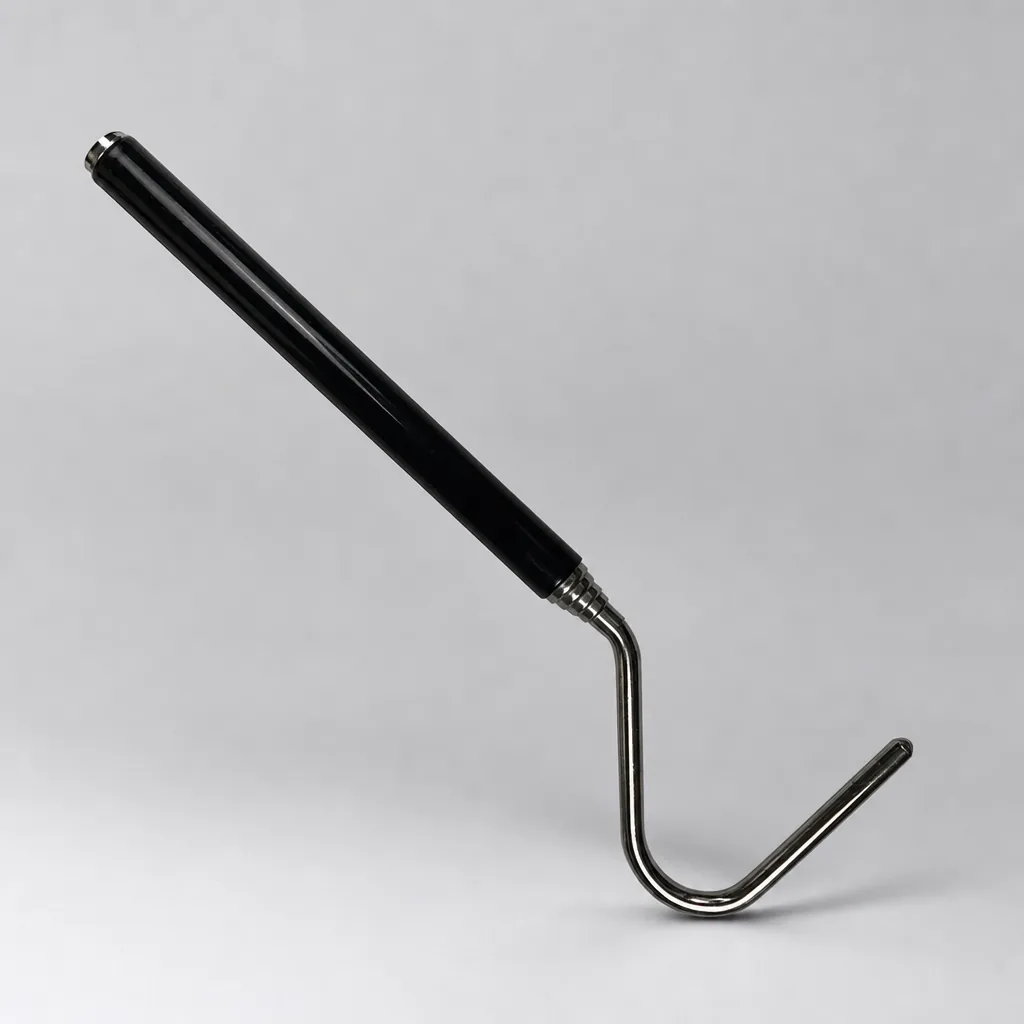
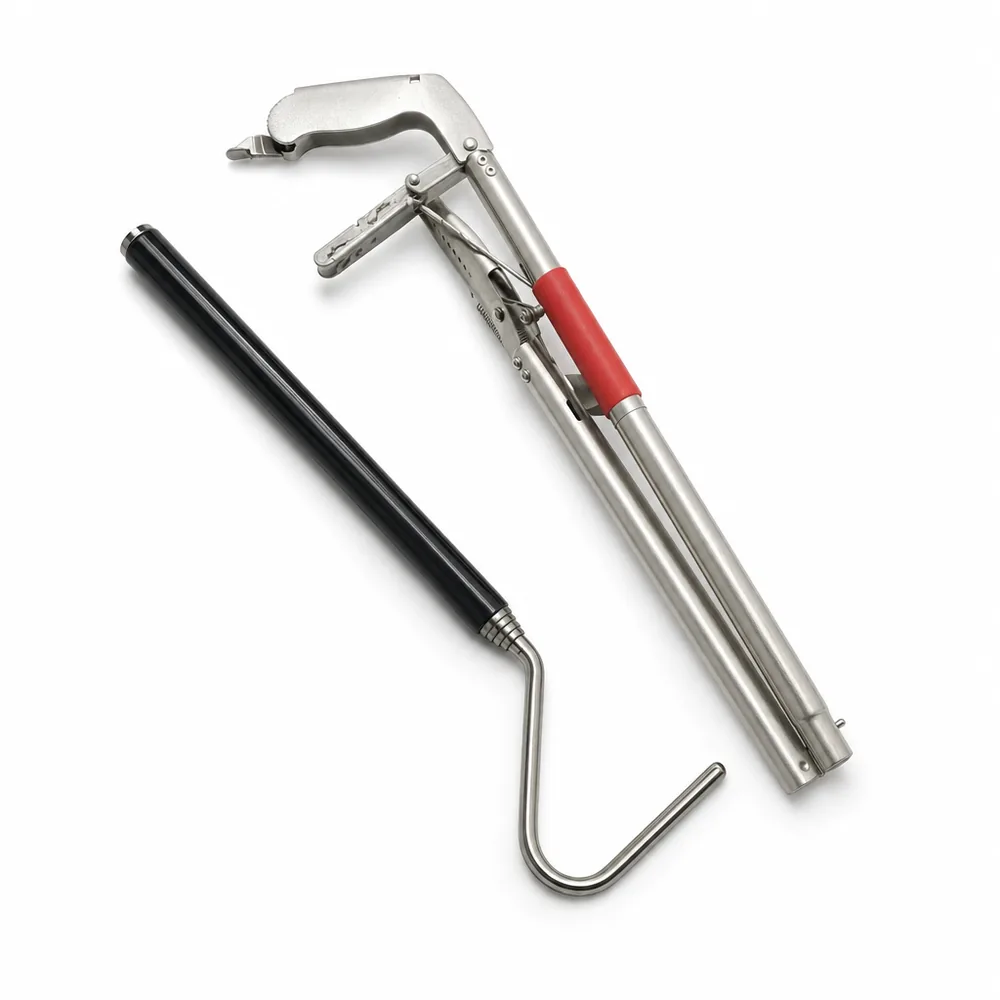
We make the first two. The Herpaxe hook is stainless steel, telescopes through six sections from 7 in (18 cm) collapsed to 26 in (66 cm) extended, and carries a curved head measuring roughly 1.8 by 2 by 2.2 in (4.5 by 5 by 5.5 cm). It is built for hatchlings, juveniles, corn snakes, kingsnakes, milk snakes and ball pythons up to about a year old. It is built and sold as a small-snake hook. An adult boa, burm or retic needs a full-size hook and a second person.
The Herpaxe tongs extend to 29.5 in (75 cm) and pack down to 17 in (43 cm), with the body sliding into itself. A tension spring and a full-hand trigger control the grip, and a lock at the elbow holds the gripping head at the angle you set before you reach into a gap. They ship with a pair of gloves and a mesh bag. The full breakdown, including one buyer who disputes the packed length, is on the snake tongs page.
Neither tool is rated for venomous species, and that is worth stating plainly rather than leaving between the lines. Both are close-work tools sized for small and mid-size snakes you have already identified as harmless. Genuine standoff distance from a dangerous animal is what the 40 to 60 in professional tools exist for, and they come with training attached.
Removal tools side by side
| Tool | What it does | Pressure on the animal | Who should use it |
|---|---|---|---|
| Snake hook | Supports and steers the body | None | Anyone, on an identified harmless snake |
| Snake tongs | Closes on the body and lifts it | Whatever you apply at the trigger | Anyone, with a light grip and practice |
| Noose pole or catch pole | Tightens a loop around the body | High, easy to overtighten | Trained handlers and researchers |
| Hardware grab stick | Grips with flat jaws, no lock | Uncontrolled | Nobody, for a living animal |
| Broom, shovel or hands | Panics or injures the snake | Maximum | Nobody |
The bottom two rows account for a large share of the stories that end at an emergency room, and both are what people reach for when they do not have a tool and do not want to wait. A hook in the garage costs less than one urgent call and removes the temptation entirely. Our technique guide covers the handling itself, and hook versus tongs covers which one to reach for.
Snake catcher FAQ
What is a snake catcher?
The word covers two things. A snake catcher is a person who removes snakes for a living, usually working for animal control or a licensed wildlife removal service. It is also the common name for the tools those people carry: a long hook that supports the body, and long tongs that close on it. If a snake is inside your home and you cannot identify it, the answer is the first meaning of the word, not the second.
Should I remove a snake myself or call someone?
Call someone whenever you cannot identify the species with certainty, whenever the snake is inside a living space, whenever a child or a pet is nearby, and always if there is any chance the animal is venomous. Handle it yourself only when the snake is clearly a harmless local species, it is outdoors or in a garage rather than in a bedroom, you have the right tool in your hand, and nothing about the situation is making you rush.
How do I know if a snake is venomous?
You often cannot, and the shortcuts people repeat are not reliable. Head shape, pupil shape and pattern all have exceptions in North America, and several harmless species mimic venomous ones closely enough to fool experienced keepers at a glance. The rule that works is the boring one: photograph the animal from a safe distance, send the photo to your state wildlife agency or a local herpetological society, and treat it as venomous until somebody qualified tells you otherwise.
What tool do professional snake catchers use?
A hook and a pair of tongs, in that order of preference, plus a bucket or a bin with a locking lid. The hook supports the body without applying any pressure, which is the gentler option whenever there is room to slide it underneath. The tongs close on the body and are used when the snake is wedged somewhere a hook cannot reach. Professionals working with venomous species use longer versions of both, along with tubes and a second handler.
What should I do while I wait for animal control?
Keep everyone and every pet out of the room, close the interior doors so the snake stays in one space, and if the room has an exterior door, open it so the animal has an obvious way out. Watch from a distance so you can tell the responder where it went, and leave it alone otherwise. Most snakes that come indoors are looking for shade, water or rodents, and most of them leave on their own once the route is clear.
How do I stop snakes coming back?
Take away the reasons they came. Control the rodent population, because rodents are why most snakes visit a property in the first place. Seal gaps under doors and around pipes, clear woodpiles and tall grass away from the foundation, keep pet food indoors, and fix standing water. Habitat work does more than any repellent product on the market, and it is the part of the job you can actually finish.
Herpaxe sells two handling tools and writes the pages that tell you when neither of them is the answer. If you came here because something is currently in your garage, the useful links are the garage walkthrough and your local animal control number. If you came here because you keep snakes, start with the telescopic hook, read what buyers said on the reviews page, and check how we set our limits on the testing page. Shipping terms are on the shipping page, returns on the refund page, and anything else on the contact page or the about page.