How We Test A Snake Hook Before We Agree To Sell It
A two-product catalog lets us do something a general store cannot: use the tools ourselves, measure them, and publish only the figures we can point to a source for.
What we measure on a hook
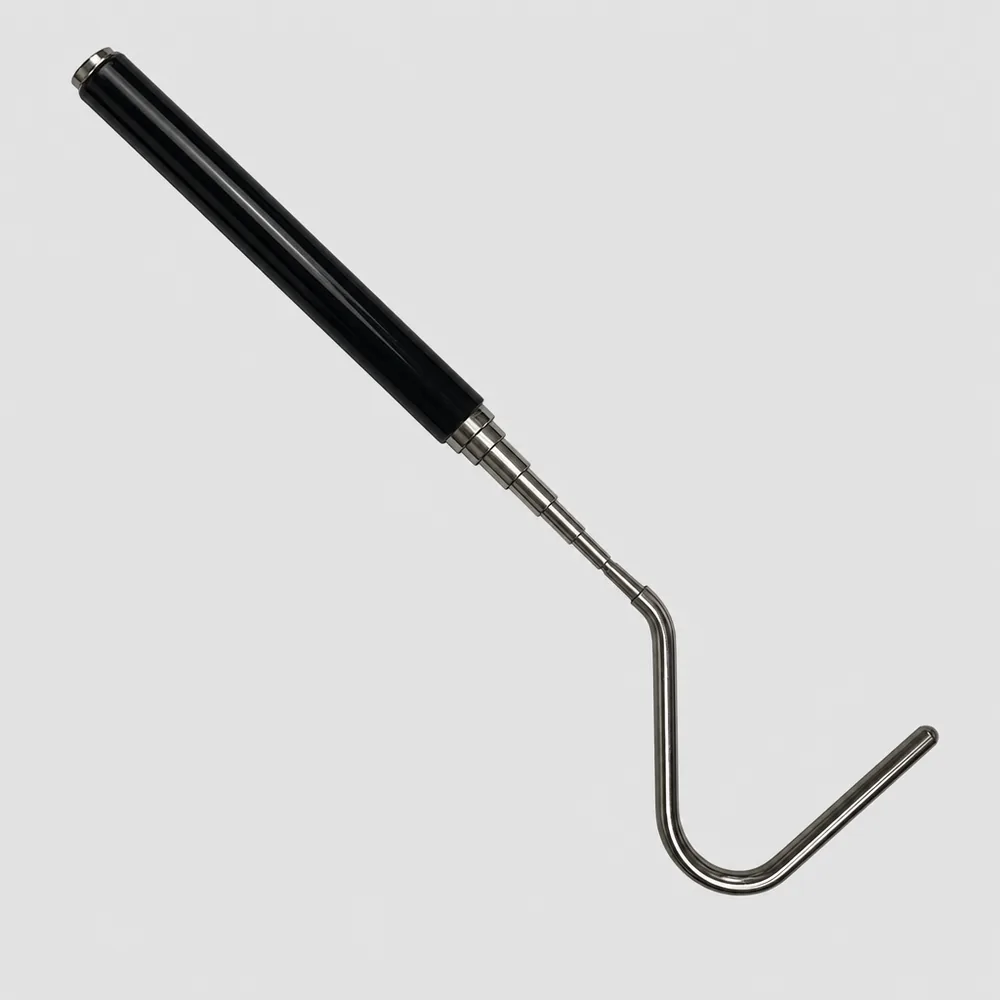
- Head geometry. The bend is the part of a hook that decides whether an animal rests on it or slides off it. We record the three dimensions of the curve, which on our hook come to roughly 1.8 by 2 by 2.2 in (4.5 by 5 by 5.5 cm), and we check the shape against the two failure modes that matter. A bend that is deep and narrow traps a body and pinches when the snake shifts. A bend that is shallow and wide lets the animal pour straight off the end. What you want for small and mid-size snakes is the middle of that range, wide enough for a body to sit across and open enough that nothing gets caught in the curve.
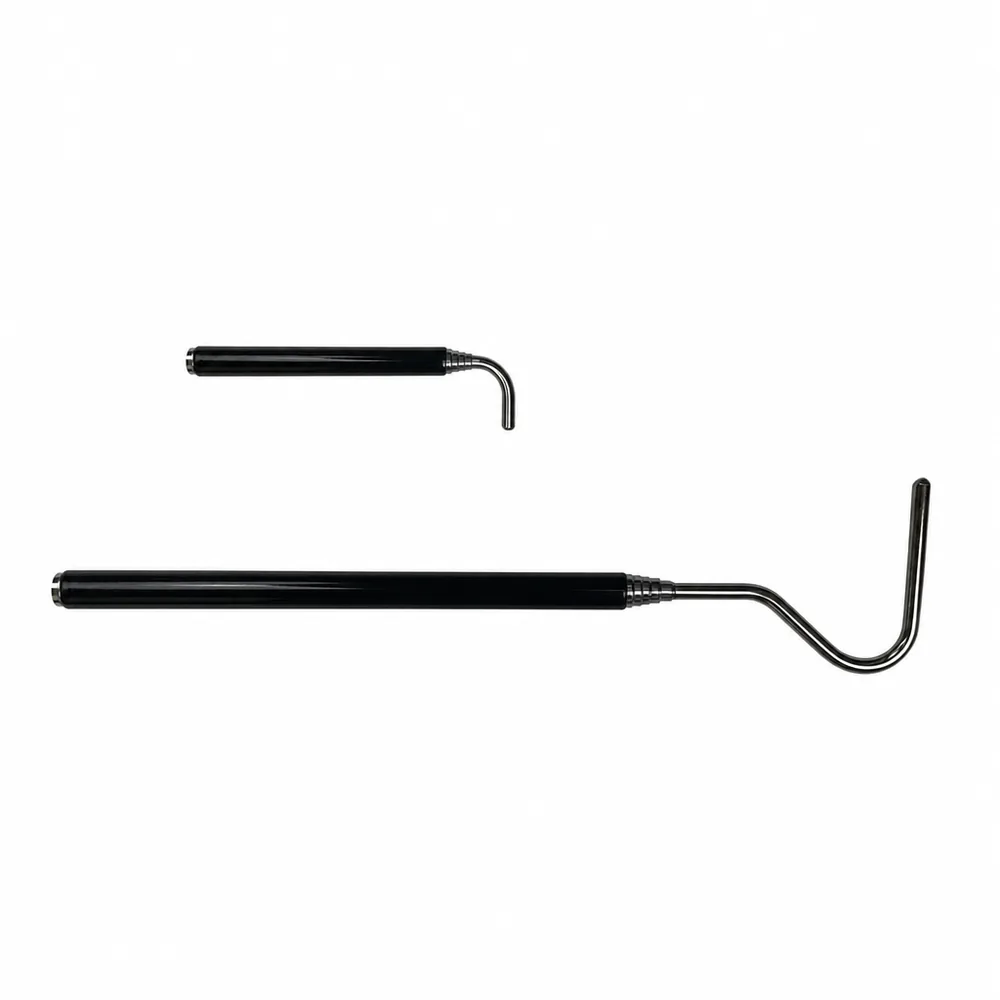
- Usable length, not headline length. A telescopic shaft is only as good as the positions you can actually work at. We note the collapsed figure, 7 in (18 cm), the fully extended figure, 26 in (66 cm), and the number of sections, six, because the number of sections is what determines how many intermediate lengths you have between the two extremes. A hook that only works fully open is a fixed hook with extra failure points.
- Section hold. The sections lock by friction, so the question is whether they stay put when a snake moves its weight along the bar rather than when the hook is sitting empty on a bench. We extend the shaft, load it and move it the way you would move it in a rack: in through a door, under the middle third of a body, lift, turn, out. A section that creeps shut mid-lift is the difference between a controlled move and a dropped animal.
- The tools in the hand that will use them. Dana kept her own collection hooked with this tool for two months before it went on sale, across hatchlings, colubrids and young ball pythons. That is the population the sizing table is built from, and it is why the table stops where it stops.
What we could not measure
There is no published weight for this hook. The spec sheet documents material, length, section count and head dimensions, and it does not document mass. We have no calibrated scale and no way to certify a figure of our own, so the specification table on the product page has no weight row rather than an invented one.
This matters more than it sounds. Weight is the spec buyers use to guess at rigidity, and a number pulled out of the air would quietly become the reason someone bought a compact hook for an animal it cannot support. A blank line is the version of that row, and the sizing table below it does the job the weight figure would have been asked to do.
The size limit we publish on purpose
Every product page here carries a ceiling. This hook is the right tool for hatchlings and juveniles of any species, for corn snakes, kingsnakes and milk snakes at full extension, and for ball pythons up to roughly a year old. Above that, an adult ball python or a small boa is workable if you support the animal with a second hand, and an adult boa, burm or retic is not: that is a full-size fixed hook and a second handler, bought from someone who sells heavy gear.
We hold that line for a reason that has nothing to do with modesty about the product. A tool used past its range is how snakes get dropped, and a dropped snake is worse for everyone than a sale we did not make.
Comparisons that name a real price
When we say a professional hook costs more, we cite the store, the product and the year rather than describing it as expensive and moving on. The figures below are the ones we check our own pricing against, and the safety numbers are the ones behind the venomous answer in our FAQ.
list price of a professional-tier titanium snake hook
— Professional-tier retail listing, 2026
venomous snakebites reported in the United States each year, with about 5 deaths
— Centers for Disease Control and Prevention, 2024
of media-reported US snakebites came from purposefully handling the snake rather than an unseen encounter
— Curry et al., Wilderness and Environmental Medicine, 2016
Those last two figures are why no page here treats a hook as permission to handle a species you are not trained for. Roughly a third of reported bites followed a deliberate decision to pick the animal up.
How the same method applies to the tongs
The folding tongs get the same treatment with different numbers: 29.5 in (75 cm) of reach deployed, 17 in (43 cm) once the body slides down into itself, an angled gripping head on an elbow that locks in position, and a tension spring worked by a full-hand trigger. They arrive with a pair of gloves and a mesh bag. What we check is whether the head closes evenly across its width and whether the elbow lock actually holds under a pull, because a tong that grips hard at the tip and loosely at the base puts all of its pressure on one point of the animal. As with the hook, there is no published weight, so no weight appears on the page.
One thing we pass on rather than smooth over: a buyer of these tongs disputed the folding claim, writing that the length does not decrease as stated. We publish both figures, 29.5 in open and 17 in closed, and that reservation alongside them, so you can weigh the packed size for yourself before you order.
What stays off our pages
Three things never make it onto a product page here. Specifications the spec sheet does not document, because a sourced blank beats an unsourced number. Statistics without a named source and a year, which is why the same three figures appear across this site instead of a rotating cast of impressive percentages. And benefits that outrun the evidence, which in practice means we describe what the steel does and leave the adjectives alone.
What we put in their place is a 30-day money-back guarantee, so if the tool is not what these pages led you to expect, the cost of that lands on us. The terms are on the refund policy page, and delivery timing is on the shipping policy.
Get the tool
The hook, the tongs and the bundle are below, with free shipping on every order. If you want the ratings before you decide, they are on the reviews page, and the story behind the shop is on the about page.
Once it arrives, the technique guide covers hook training and the four rules that prevent most handling mistakes, the ball python guide deals with feeding response, and the catcher guide is the one to read before a snake shows up in your garage. Everything else is in the guides section, and questions reach us through the contact page.