Folding Snake Tongs That Extend To 29.5 Inches And Lock At The Elbow
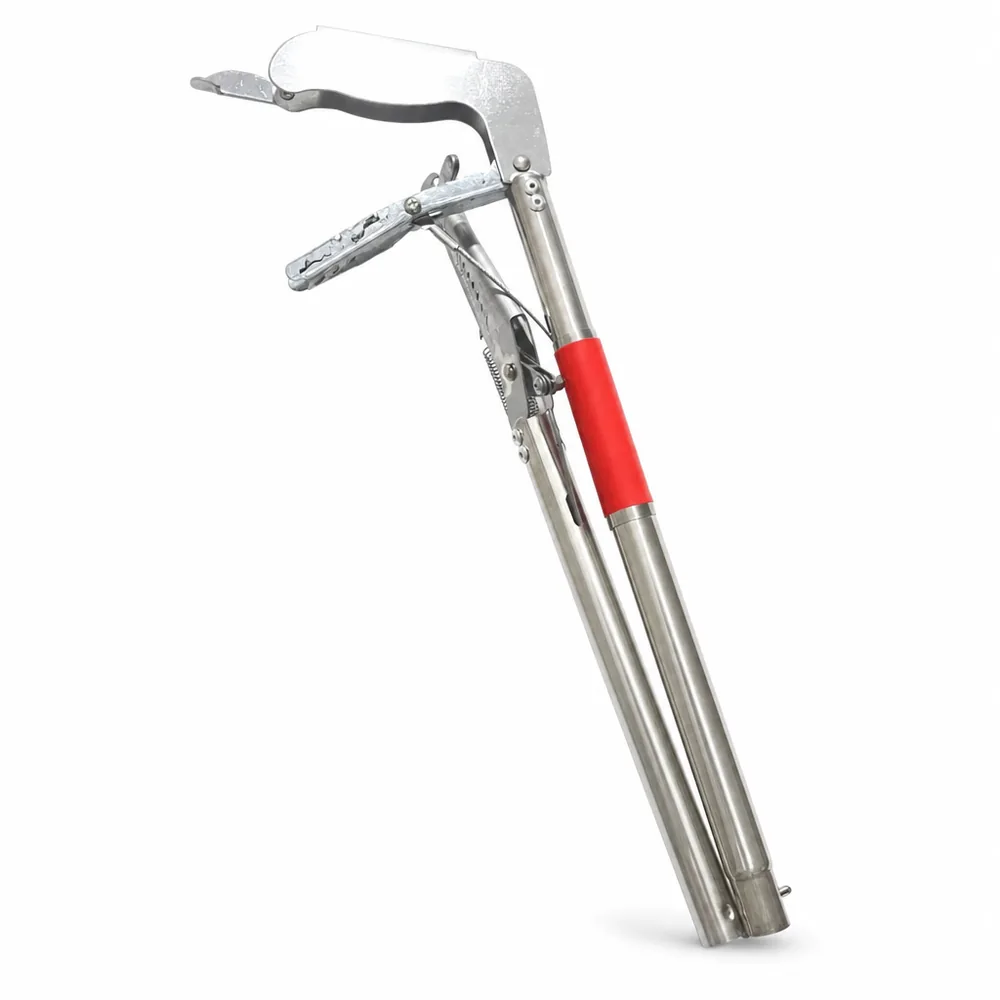
Stainless steel with a red grip handle, an angled gripping head on a tension spring, and a locking elbow that holds the head where you set it. The body slides into itself for transport.
✓ Gloves and mesh bag included ✓ Free shipping ✓ 30-day money-back guarantee
What snake tongs are, in one paragraph
People search for this tool under three different names and mean the same thing by all of them. A snake grabber, a snake grabber tool and a pair of snake tongs are one product: a reaching arm with a head that closes. The wording changes depending on whether the buyer came from the reptile hobby, from wildlife removal work, or from a hardware aisle where the same mechanism is sold as a litter picker. What changes between those versions is the head shape, the spring, and whether the maker thought about a living animal at the other end.
That last point is the one worth paying for. A hardware grabber has flat plastic jaws and nothing holding them in place, so the grip is whatever your hand happens to be doing at that second. This tool uses an angled head that matches the round cross-section of a body, a tension spring firm enough that the head stays where you put it, and a full-hand trigger rather than a two-finger squeeze. Those details are the difference between moving an animal and squeezing one.
These are close-work tongs, not distance tongs
We put this number on the page rather than in the small print. At 29.5 in (75 cm) extended, this tool is roughly the length of the arm it replaces. It is not in the same category as the 40 to 60 in tongs that professional handlers carry, and the reason those exist is the only reason that matters: a venomous animal can reach further than most people think, and the length of the tool is what keeps the handler outside that arc.
What 29.5 in gives you is a hand that is not on the snake. That is a real benefit for a corn snake in a rack, a garter snake under a step or a kingsnake behind a bin, and it is what this tool is built for. What it does not give you is safe standoff from a species that can hurt you. Venomous handling is a trained discipline with much longer tools and its own protocols, and the snake catcher guide sets out what to do when that is the animal in front of you.
Being clear about that ceiling is the same policy we apply to the telescopic hook, which we sell as a small-snake tool rather than a heavy-duty one. Our testing page explains how we set those limits.
Three situations where you put the hook down and pick up tongs
The snake is wedged where nothing can slide underneath. Behind a water heater, under a shed, inside a stack of firewood. A hook needs clear space beneath the body to work at all, and none of those places offer it. Tongs approach from the side and take the animal out the way it went in.
The snake is anchored and will not let go. A snake that has wrapped a branch, a rack bar or a length of pipe cannot be lifted on a hook, because the hook lifts the loose part of the body and leaves the anchor behind. A grip on the middle third, held steady while the animal decides to release, does work.
The animal is moving and you need it to stop. A hook works on a snake that is willing to sit on it. A snake that has decided to leave requires something that closes.
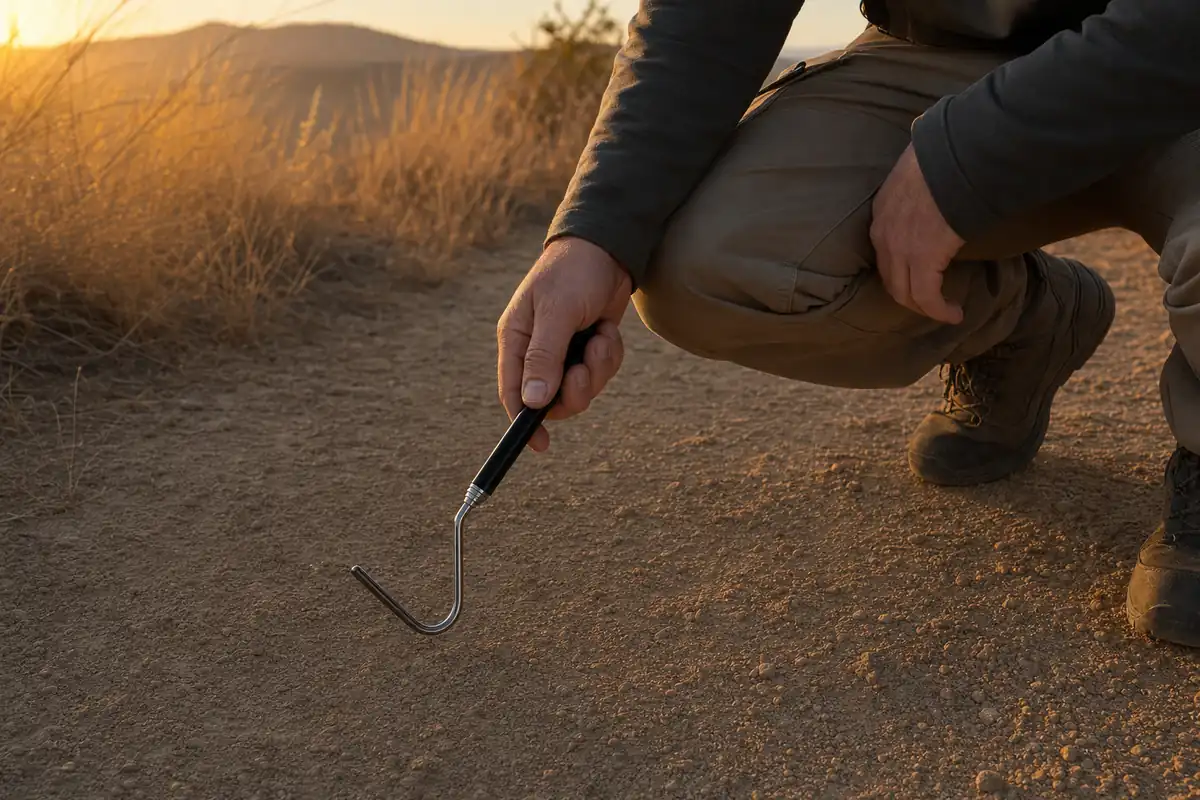
None of this makes tongs the better tool. It makes them the second tool. Inside an enclosure, on a calm animal, a hook is gentler and faster every single time, which is why the snake hook page is the one most keepers land on first. The comparison in hook versus tongs goes through the trade-off in more detail.
The spring, the trigger and the locking elbow
The locking elbow is the feature people underestimate until the first awkward removal. Reaching behind an appliance or under a step means approaching the animal at an angle, and a head that pivots freely at the end of a shaft will rotate the moment it touches anything solid. Locking the angle before you reach in means the head arrives in the orientation you chose, which is the difference between a clean pickup and three attempts that push the snake further into the gap.
The spring does the other half of the work. It holds the head closed on its own, so a grip you set stays set while you move, and the trigger is sized for a whole hand rather than two fingers, which is what lets you close gently and hold that position. Fine control is the point. A tool that only knows open and slammed shut is a tool that injures animals.
How much pressure to apply, and how to tell you have it right
The answer is that you want the least pressure that stops the snake sliding out, and not a bit more. In practice that means three habits. Close on the middle third of the body, never on the neck and never near the tail, because the middle is the part that can take a load and the ends are the parts that get damaged. Support the hanging weight with your free hand, with a hook or against the ground rather than letting the whole animal dangle from one point of contact. And keep the trip short, because a snake held for thirty seconds and released into a bin is a very different experience from a snake carried around the yard while you decide where to put it.
If the snake starts twisting hard against the head, that is not a signal to squeeze harder. It is a signal to lower it onto a surface and let it take its own weight. Tightening a grip on an animal that is already fighting is how ribs get broken, and it is the single most common mistake people make with this tool.
29.5 inches open, 17 inches packed
The body slides into itself through two tubes. Extended, the tool measures 29.5 in (75 cm) from handle to head. Folded, it is listed at 17 in (43 cm), which fits a backpack, a truck toolbox or the same field bag that carries a collapsed hook.
There is one caveat we are not going to bury. Among the written feedback we collect, one buyer contests exactly this claim and states that the length does not decrease as stated. That is a single report against a published specification, and we cannot tell you which of the two is right from where we sit. What we can tell you is that we print the published figure and the objection side by side, and that the 30-day money-back guarantee exists precisely for the case where a spec turns out to matter more to you than it did to us.
What comes in the box besides the tongs
The tongs ship with a pair of gloves and a mesh bag. Neither is a luxury item and neither turns this into a kit for dangerous species, but both are genuinely useful. The gloves are there for the part of the job that happens after the snake is contained, when you are moving debris, lifting boards or clearing the woodpile that attracted it. The mesh bag holds the folded tool in a bag or a trunk so the head is not catching on everything else you own.
What else it is documented for
The spec sheet names four uses, and they are worth repeating because they explain the design. Snakes, crawfish, litter pickup and fishing. A crawfish is a small, fast, pinching animal that nobody wants to grab by hand, which is the same problem the tool solves for a snake. Litter pickup is where the locking grip and the trigger come from in the first place. Fishing means handling a hooked fish without putting a hand near it. If you bought this for reptiles and it ends up living in the trunk for pond work and roadside cleanup, that is exactly how the design expects to be used.
Which situation calls for which tool
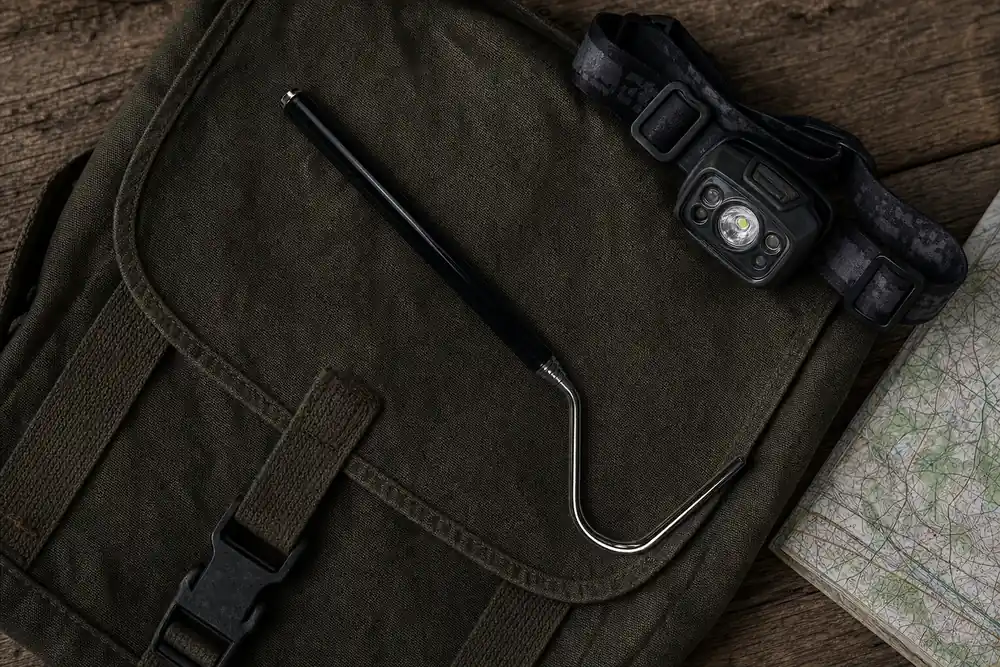
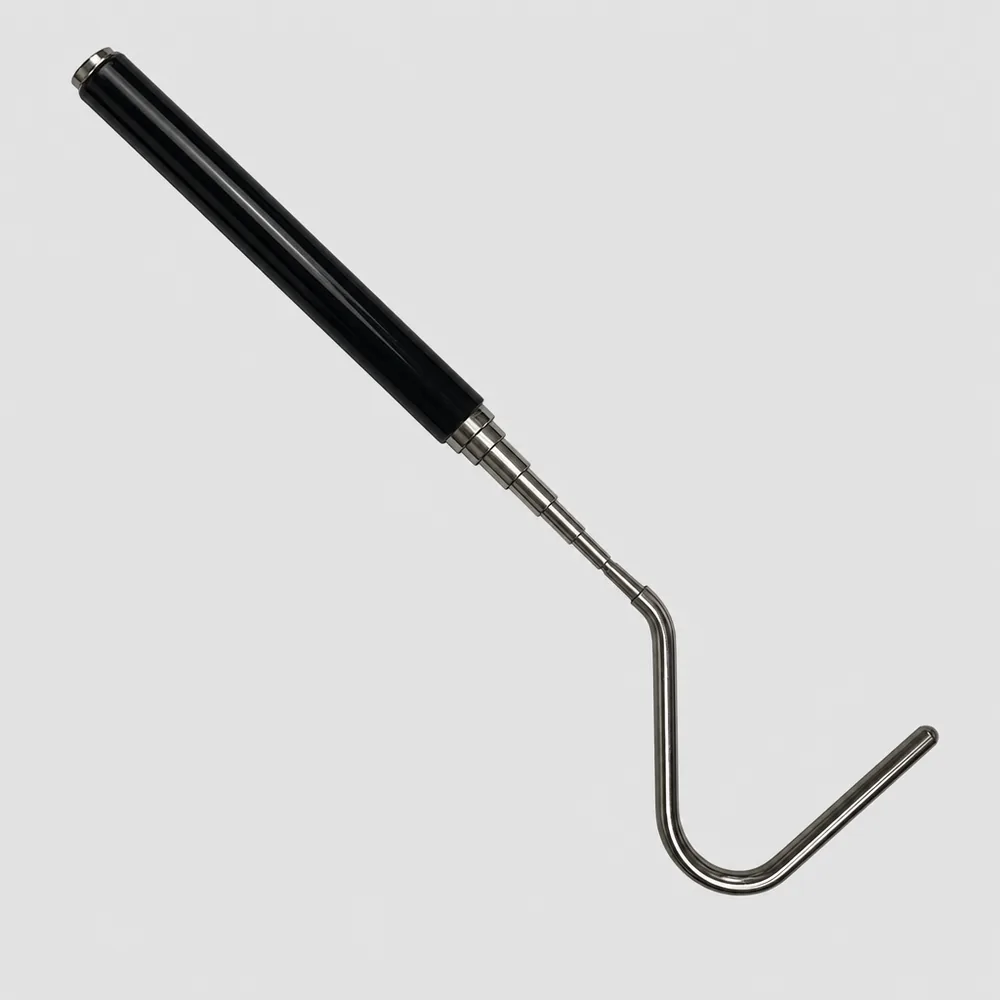
Most listings for grabbers give you a length and stop there. Length is the wrong variable, and on these two tools it barely separates them at all: our hook extends to 26 in (66 cm) and these tongs to 29.5 in (75 cm), a difference of about three and a half inches. The variable that actually decides which one you should be holding is whether anything can pass underneath the snake. Below is that decision written out for the situations keepers and homeowners actually run into.
| Situation | Room under the body? | Right tool | Why |
|---|---|---|---|
| Moving a calm snake in or out of an enclosure | Yes | Hook, short setting | Nothing needs to close on the animal at all |
| Defensive animal at the back of a rack | Yes | Hook, full extension | Support beats grip whenever support is possible |
| Snake behind a water heater or under a shed | No | Tongs | No clearance beneath the body for a hook head |
| Snake coiled around a branch or a rack bar | Not usefully | Tongs | A hook lifts the loose body and leaves the anchor |
| Snake crossing open ground and moving away | Yes, but it will not stay | Tongs, lightest grip | Closing on the body is the only thing that stops it |
| Snake in deep brush or a woodpile | No | Tongs, elbow locked first | The angle has to be set before you reach in |
| Heavy-bodied adult boa, burm or retic | Not the issue | Neither of ours | Both tools are sized for small and mid-size snakes |
| Any venomous species | Not the issue | Neither of ours | Trained protocol, far longer tools, licensed handler |
Read the last two rows as hard limits rather than as caution. A tool sold with a ceiling is more useful than one sold without one.
What keeping your hand off the animal is worth
venomous snakebites reported in the United States each year, with about 5 deaths
— Centers for Disease Control and Prevention, 2024
of media-reported US snakebites came from purposefully handling the snake rather than an unseen encounter
— Curry et al., Wilderness and Environmental Medicine, 2016
entry list price of professional-series snake tongs, running up to $139.95 for the long standoff models
— Professional-tier retail listing, 2026
The middle figure is the one that should shape how you use this tool. Roughly a third of reported bites happened because somebody decided to pick the animal up. A grabbing head is only an advantage if it replaces a hand rather than encouraging one.
Only 32.1% of bites were deemed illegitimate bites that resulted from the purposeful handling of the snake.Curry, Bond, Kunkel et al., "An Analysis of Media-Reported Venomous Snakebites in the United States, 2011-2013", Wilderness and Environmental Medicine, 2016
The two tools side by side
| Snake hook | Snake tongs | |
|---|---|---|
| What it does | Supports and steers the body | Closes on the body and lifts it |
| Length extended | 7 to 26 in (18 to 66 cm) | 29.5 in (75 cm) |
| Packed length | 7 in (18 cm), telescoping | 17 in (43 cm), body slides in |
| Pressure on the animal | None | Whatever you apply at the trigger |
| Works with no clearance under the snake | No | Yes |
| In the box | 1 hook | Tongs, gloves, mesh bag |
| Best for | Daily enclosure work | Sheds, garages, brush, awkward corners |
| Price here | $24.95 | $49.95 |
The pair together is $67.95 as the field bundle, which is $36.95 less than the two at full price. That is the setup we would take into a garage: the tongs to get the animal out of wherever it has gone, and the hook to carry it the rest of the way once it is in the open and calm. The garage removal walkthrough is written around exactly that sequence.
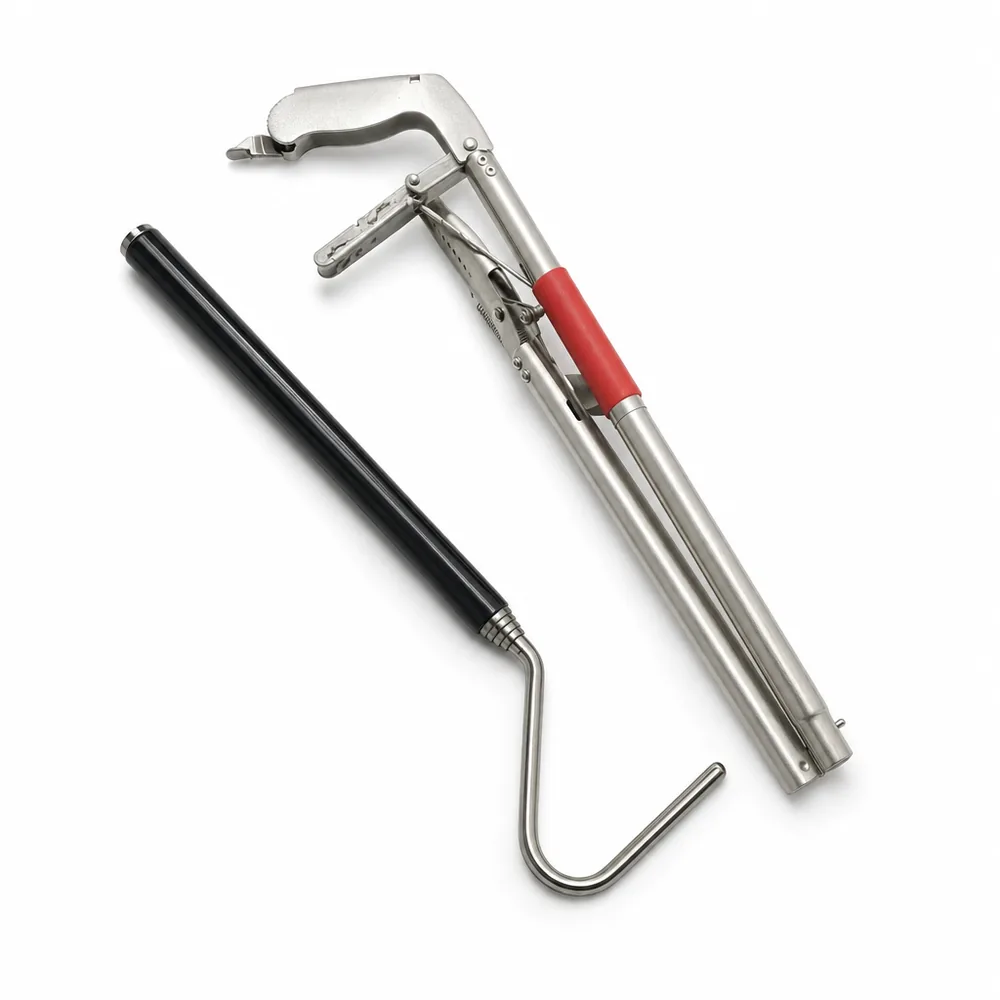
What you actually receive
| Spec | Value |
|---|---|
| Material | Stainless steel, angled gripping head, red grip handle |
| Length extended | 29.5 in (75 cm) |
| Length packed | 17 in (43 cm), the body slides into itself |
| Grip control | Tension spring, full-hand trigger |
| Head | Curved, locking elbow that holds the set angle |
| Documented uses | Snakes, crawfish, litter pickup, fishing |
| In the box | 1 pair of tongs, 1 pair of gloves, 1 mesh bag |
Everything in the table above comes from the spec sheet for the version we actually stock, and the shipping terms are on our shipping page.
Verified buyer ratings
"Good product. I recommend"
Verified buyer · January 20, 2026
"Now let's go catch snakes."
Verified buyer · December 12, 2025
"Very nice."
Verified buyer · September 10, 2025
The full list of ratings, including the two 4-star ratings from May and July 2026, is on the reviews page.
Snake tongs FAQ
What are snake tongs used for?
Snake tongs close an angled gripping head around a snake so you can lift it and carry it without putting a hand on the animal. Keepers reach for them when a hook cannot do the job: a snake wedged behind a water heater, coiled inside a woodpile, or anchored around something it will not release. The same tool is used for crawfish, for litter pickup and for handling a hooked fish, which is how the spec sheet documents it.
How long should snake tongs be?
It depends entirely on what you are doing. Professional handlers who work with venomous species use tools in the 40 to 60 in range, because the whole point of their equipment is standing outside the strike arc of an animal that can kill them. These tongs are not that. They extend to 29.5 in (75 cm), which makes them a compact grabbing tool for close work on species you have already identified as harmless. If you need genuine standoff distance, you need a longer tool and training to go with it.
Do snake tongs hurt the snake?
They can, and that is a matter of technique rather than of the tool. A snake gripped hard across the ribs or held by the neck can be injured in seconds. Closed gently around the middle third of the body, with your free hand or the ground supporting the weight, tongs apply about as much pressure as a firm handshake. The rule that keeps animals safe is simple: close only as far as it takes to stop the snake sliding out, never further, and never squeeze harder because the animal is struggling.
Snake tongs or a snake hook: which one do I need?
Buy the hook first if your work is routine enclosure keeping, because it never applies pressure to the animal at all. Buy the tongs if you also deal with snakes in sheds, crawl spaces or brush, where you cannot get a hook underneath the body. The two tools are close in length, so the reason to own both is not extra reach. It is that one supports and the other closes, and those are different jobs.
How far do these tongs actually fold down?
The spec sheet gives 29.5 in (75 cm) extended and 17 in (43 cm) folded, with the body sliding into itself through two tubes. One buyer disputes that and wrote that the length does not decrease as stated. We cannot reconcile the two claims from where we sit, so we publish both. If the folded length is the reason you are buying, the 30-day money-back guarantee covers you.
Can I use these tongs on a venomous snake?
No. Venomous handling is a trained discipline with its own protocols, much longer tools, tubes and a second person, and it is regulated in many states. A 29.5 in tool puts your hand well inside the range of an animal that decides to turn around. If a venomous snake turns up at your home, call your local animal control or a licensed removal service. Our snake catcher guide walks through how to tell an emergency from a garden snake before you touch anything.
If you are still deciding, the shortest version is this. Buy the hook if your snakes live in enclosures and your problem is moving them safely. Buy the tongs if your snakes turn up in corners you cannot get a hook into. Buy the bundle if both sentences describe your year. Whatever you choose, read the snake catcher guide before the first removal, keep the field gear checklist handy for road trips, look at the handling technique guide before the first pickup, and write to us through the contact page if a spec on this page does not match what arrives. More about who we are is on the about page.