· Dana Whitfield
Snake hook vs snake tongs: what each tool is actually for
We sell both tools, so treat this page as a comparison written by someone with an obvious interest and read it accordingly. The useful version of that disclosure is not a promise of neutrality, it is a promise of specifics. Below is where each tool wins, where each one loses, and the two situations where reaching for the wrong one causes real harm to the animal. If you only ever keep colubrids in racks, the fourth section is the one that answers your case.
The mechanical difference in one paragraph
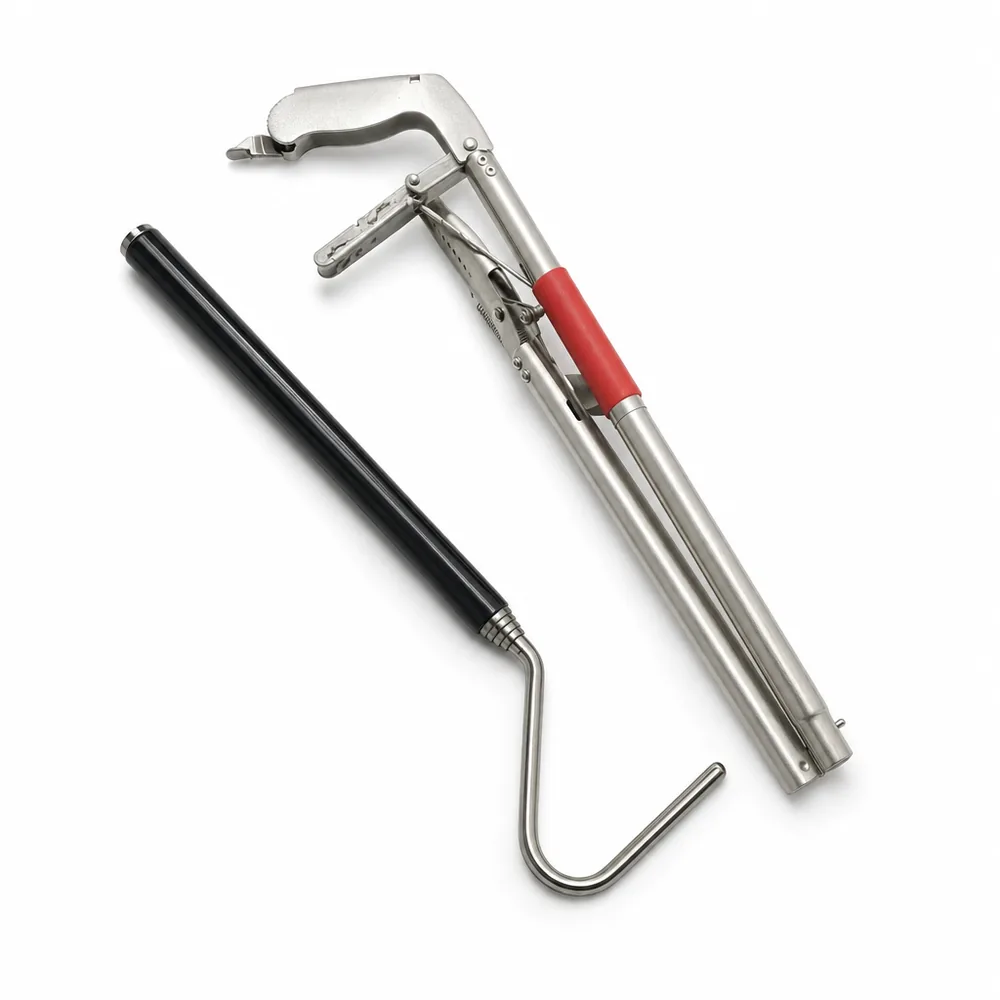
A hook is a passive tool. It is a shaft with a bend on the end, and the only force it applies is upward. The snake rests across the curve the way it would rest across a branch, and it can leave whenever it decides to. Nothing closes on it, nothing holds it, and the handler controls direction rather than the animal. That is the whole mechanism, and its simplicity is exactly why it works.
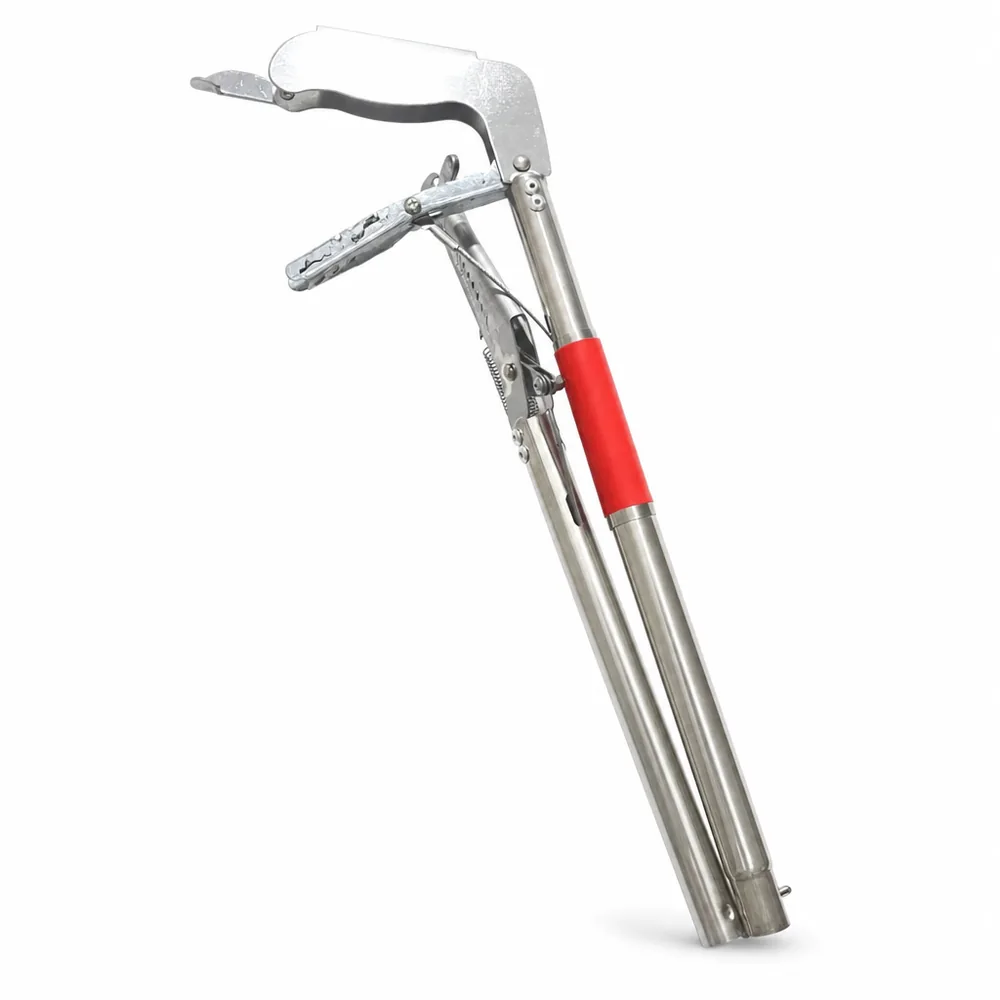
Tongs are an active tool. Squeezing the full hand trigger closes an angled grabbing head around the body, and a tension spring keeps that closure loaded until the handler releases it. The animal is held, not supported, and it cannot simply decide to leave. Ours are stainless steel with a red grip, they extend to 29.5 in (75 cm), and they fold down to 17 in (43 cm) on an elbow joint that locks the head in position. Each pair ships with one pair of gloves and one mesh bag.
Notice what those numbers do not say. A 29.5 in tong against a 26 in hook is three and a half inches of extra reach, which is nothing. Anyone selling you tongs on the promise of standing much further back is selling you a different tool than this one. The reason to own them is the grip, and the rest of this page is about what that grip buys you.
Pressure on the animal is the real dividing line
Everything else in this comparison follows from one fact. A hook applies zero clamping force. Tongs apply some, always, even when used correctly. A well designed spring tong applies far less than a hardware store grabber, and a trained handler applies less than an untrained one, but the number is never zero. That is the price of being able to hold on.
So the rule that experienced keepers converge on is simple. Use the tool that applies no pressure unless the situation makes it impossible. In a home collection, the situation almost never makes it impossible. In a garage, a woodpile or a crawlspace, it frequently does. Neither of those statements is marketing, they are just consequences of the geometry.
There is a second consequence that matters for the snake's behavior over time. An animal that is only ever supported learns that the tool is neutral. An animal that is regularly gripped learns that the tool means restraint, and it starts reacting to the sight of it. Keepers with large collections build their entire routine around keeping the daily tool boring, which is why the hook lives on top of the rack and the tongs live in the truck.
Hook and tongs, side by side
| Criterion | Snake hook | Snake tongs |
|---|---|---|
| Mechanism | Supports from below, nothing closes | Angled head closes on the body, tension spring |
| Pressure on the animal | None, the snake rests on the bar | Controlled but always present |
| Can the snake leave on its own | Yes, at any moment | No, not until you release the trigger |
| Works on a wedged or anchored snake | No, there is nothing to lift from under | Yes, that is the whole point |
| Works in a tight enclosure | Yes, shorten the shaft | Poorly, the head needs room to open |
| Length | 7 to 26 in (18 to 66 cm), telescopic | 29.5 in (75 cm) extended |
| Transport | Collapses to about 7 in (18 cm) | Folds to 17 in (43 cm) on a locking elbow |
| In the box | 1 hook | Tongs, 1 pair of gloves, 1 mesh bag |
| Best for | Daily enclosure work, feeding week, road finds | Recovery from cover, coiled animals, awkward angles |
| Price here | $24.95 | $49.95 |
Two honest notes on that table. The length row is the one that surprises people: the extra reach over a hook is marginal, so these tongs are a close-work tool rather than a stand-across-the-room one. And on the transport row, a buyer left a three star rating stating that its length does not decrease as stated, so the folded figure is disputed by at least one customer. We publish the spec sheet number and that reservation together rather than one without the other. The full rating history sits on the reviews page.
When tongs are the wrong choice
Routine enclosure work is the clearest case. Opening a rack drawer, moving a ball python to a weigh tub, taking a corn snake out for a cage clean: none of these needs a grip, and using one adds pressure to an animal that was going to cooperate anyway. A hook does the same job with nothing closing on the snake, and it does it faster because there is no aiming involved.
Hatchlings and small bodied colubrids are the second case. A grabbing head closing on an animal the diameter of a pencil concentrates whatever force is applied onto a very small area, and a hatchling in a deli cup is not going anywhere that requires holding it in the first place. Support it, do not grip it.
Feeding response management is the third. Tapping the substrate with a shaft before you open a door is a hook habit, and it is the single most useful safety routine in snake keeping. Tongs cannot do it well, because the head geometry makes the tap imprecise and the animal reads a different signal each time. The technique guide walks through that routine step by step.
And the fourth case is the one nobody admits to. Tongs feel decisive, which makes them tempting when a keeper is nervous. Nervous plus decisive is how animals get squeezed. If your instinct is to reach for tongs because the snake is being difficult, that is usually the moment to slow down and use a hook instead.
When a hook is not enough, and what the market charges
A hook fails the moment the snake is wedged. Behind a water heater, under a shed, inside a woodpile, between a rack and a wall: there is nothing to slide the curve under, and even if there were, lifting requires the animal to be free to rise. This is the job tongs were invented for, and no amount of technique makes a hook do it.
A hook also fails in dense brush and tall grass. Field herping means the animal is often lying inside vegetation that blocks any lift from below, and a snake that is half under a mat of grass cannot be balanced on a bar because it was never free to rise in the first place. Closing on the body through the cover is the only move available, and a locking elbow lets you set the head angle before you commit to it. Our catching guide covers the outdoor version of this problem, and the tongs page lists the full specifications.
Finally, a hook fails on any animal that will not stay on it. An anchored constrictor is the obvious version: once a snake has wrapped a branch, a shelf or the shaft itself, prying at it with a hook is how ribs get bruised. The quieter version is the animal that simply pours off the curve every time you lift, over and over, until both of you are stressed. A hook lets a snake leave whenever it wants, and that freedom is a feature nine times out of ten and a dead end the tenth. Tongs are what you own for the tenth.
Price is the last piece of context, because it explains why keepers hesitate over a second tool. At the professional tier, a titanium snake hook lists at $69.95 and professional-series tongs run from $79.95 to $139.95 (professional-tier retail listings, 2026). That tier is built for animal control work and priced for departmental budgets. Our hook is $24.95 and our tongs are $49.95, which is roughly the cost of one professional tool for both. What you give up at that price is heavy duty capacity, and we say so plainly on the hook page and in the how we test notes. If you keep hatchlings and juveniles indoors, buy the hook. If you also pull snakes out of garages and brush, the bundle exists for exactly that reason. And if you would rather build the hook half of that setup yourself, the DIY guide covers what works and what fails, while our story explains why we price the way we do.