· Dana Whitfield
Field herping gear checklist: what actually earns bag space
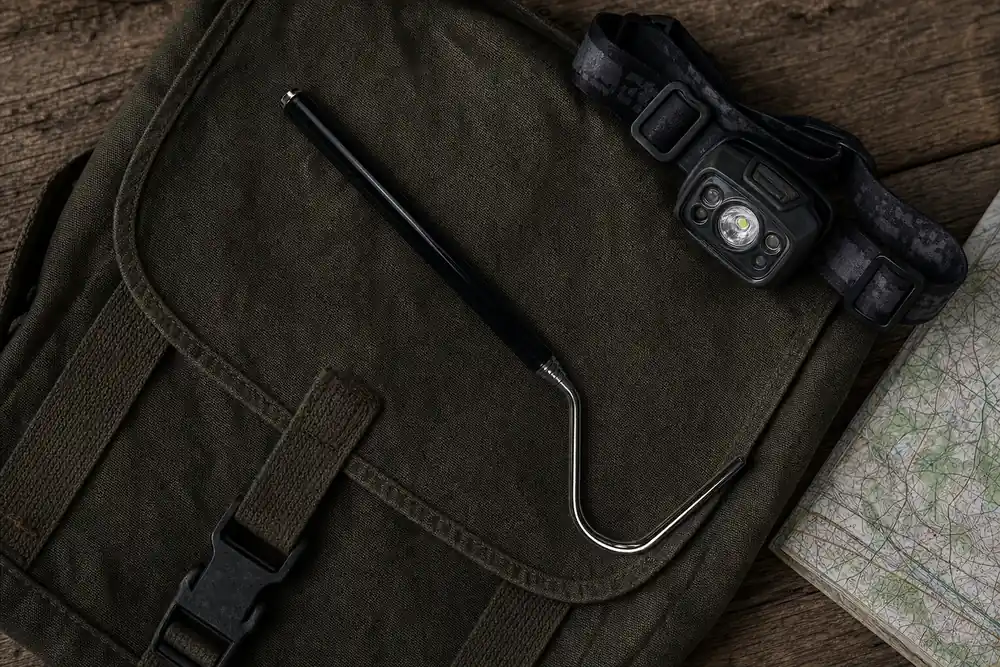
The gear lists you find for field herping tend to be written by people packing for a photograph rather than for a night out walking. Mine got shorter every season for eleven years, and it stopped shrinking at about nine items. What follows is that list, what each thing is for, and the part that matters more than any of it, which is how you behave once you actually find something.
The checklist
| Item | Why it earns the space | Priority |
|---|---|---|
| Headlamp, plus a handheld backup | Hands free for walking and lifting, backup for when the first one dies | Essential |
| Spare batteries | The single most common reason a night ends early | Essential |
| Telescopic snake hook | Lifts and steers without hands, collapses into a pocket | Essential |
| Boots over the ankle | Footing on loose rock, protection in tall grass | Essential |
| Water, more than planned | Heat exhaustion ends more trips than anything else | Essential |
| Phone, charged, plus a battery pack | Maps, photos, and the only emergency call you get | Essential |
| Camera or a phone with a decent macro | The record is the point of the trip | Recommended |
| Field notebook or a logging app | Date, location, weather, species, all easy to forget by morning | Recommended |
| Basic first aid kit | Cuts, blisters, ticks, all far more likely than a bite | Recommended |
| Folding tongs | Only for reaching under debris where a hook cannot go | Situational |
| Hand sanitizer or wipes | Before and after any contact with an animal | Situational |
Light comes first, and then more light
Most herping happens after dark or at dusk, which makes your light the item that determines whether the trip works at all. A headlamp keeps both hands free, which matters the moment you need to lift a board or steady yourself on a slope. Buy one with a red mode, because red light disturbs animals far less than white and it preserves your night vision between finds.
Carry a second light. This is not gear enthusiasm, it is the most practical advice on this page. A headlamp that dies two miles into a canyon at eleven at night turns a good evening into a slow, careful walk back. A small handheld light in a pocket weighs nothing, and it doubles as the tool you use to look under things without putting your face where your hand is about to go.
Road cruising has its own light rules. You are looking for shapes on warm asphalt after sunset, so drive slowly, use your headlights rather than a spotlight through the windshield, and pull fully off the road before you get out. Wear something reflective. The genuine danger of a night on a back road is not the wildlife, it is the pickup truck coming around the bend.
The hook, and why a telescopic one lives in a pocket
A hook in the field does two jobs. It lets you lift a snake clear of the ground for a photograph or an identification without gripping it, and it lets you move an animal off a road before the next car arrives. Both of those are better done with a bar than with your hands, for the snake and for you.
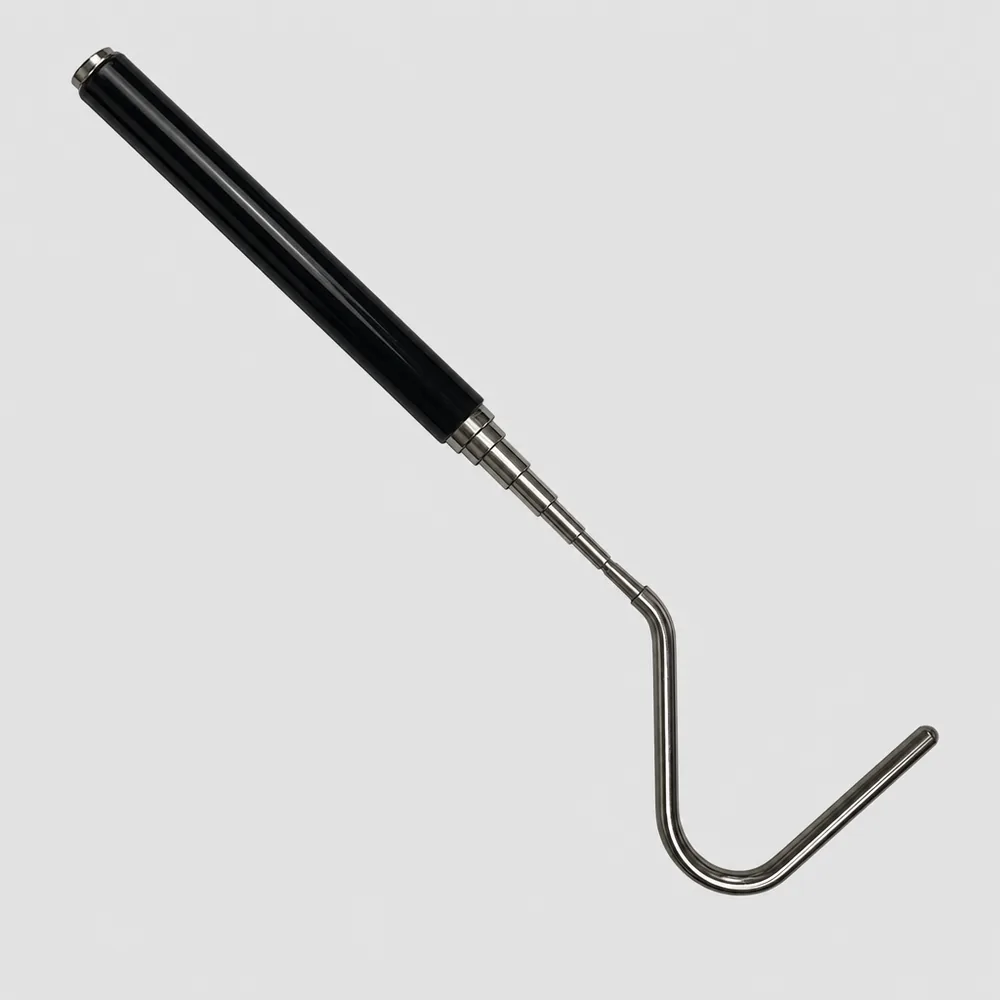
The catch with field hooks is that the good ones are long, and a 40 in fixed shaft is a nuisance to carry on foot and a worse one in a car. That is the entire argument for a telescopic design. Our hook is stainless steel through six sections, 7 in (18 cm) collapsed and 26 in (66 cm) extended, with a curved head of roughly 1.8 by 2 by 2.2 in (4.5 by 5 by 5.5 cm), and it rides in a jacket pocket or a glovebox without a case. The best hook on any given night is the one you actually had with you. Specifications and the sizing limits are on the hook page, and the technique is in how to use a snake hook.
Tongs are the situational entry on the list. Folding tongs grip where a hook can only support, which is what you need when a snake is wedged in a debris pile or anchored under a sheet of tin and will simply slide off a crook. They fold to 17 in for transport. It is not a substitute for a hook, and it is not something to reach for casually, because tongs apply pressure and a hook does not. The comparison guide covers the split, and the tongs page has the dimensions.
Boots, water and the unglamorous half
Footwear over the ankle with a real sole is the item people skip and regret. Herping terrain is loose rock, wet clay, tall grass and rotting logs, usually in the dark, and a rolled ankle three miles from the car is the worst realistic outcome of a night out. Snake gaiters are a reasonable addition in rattlesnake country if it makes you walk more calmly, though good boots and looking where you step do most of the work.
Water is the other one. Spring and summer herping in the southeast means humidity that drains you faster than the walking does, and dehydration arrives quietly. Carry more than the trip should need, and add electrolytes if you are out for a full night. Long sleeves and long trousers in light fabric beat shorts even in heat, because they handle brush, ticks and mosquitoes at once.
Tell someone where you are going and when you expect to be back. Drop a pin before you lose signal. Screenshot the map, since coverage in the places worth herping is unreliable. None of that is gear, and all of it matters more than the contents of your bag.
Field ethics, which is the part that lasts
Everything you flip, you flip back. A board, a rock or a sheet of tin is a microhabitat that took months to become useful, and putting it back exactly as it was is the single most important habit in the hobby. Lift the far edge toward you so the object is between you and whatever is underneath, look, then lower it slowly rather than dropping it. If an animal is sitting where the cover has to come down, wait for it to move or place the cover back around it.
Do not move animals. A snake photographed where it was found is data, and a snake carried to a prettier log for a better picture is a snake in unfamiliar territory with no idea where its shelter is. Staged photos also break the record, since location is the reason anyone else cares about your find. Take the picture where the animal is, log the date and the coordinates, and move on.
Handling deserves the same restraint. Plenty of species can be lifted briefly on a hook for an identification, and plenty of others are best left entirely alone. Venomous animals are photographed from a distance, full stop. The reason is not squeamishness, it is arithmetic: in an analysis of media-reported venomous snakebites in the United States between 2011 and 2013, 32.1% resulted from someone purposefully handling the snake (Curry, Bond, Kunkel et al., Wilderness and Environmental Medicine, 2016). A third of those injuries came from a decision, not an accident. No photograph is worth being in that third, and nothing we sell changes that math.
Then there is the law, which varies more than newcomers expect. Collection limits, protected species lists, permit requirements and rules about which state lands you may search at night are set state by state, and some parks prohibit night access altogether. Check your state wildlife agency before you go rather than after, keep to public land or ask permission on private property, and never post exact coordinates for a sensitive or heavily collected species. Wash your hands or use sanitizer between sites too, because moving pathogens between populations on your boots and gear is a real risk to the animals you came to see.
Pack it in this order and the list stops feeling like shopping. Light, hook, boots, water, camera, notebook, and the discipline to put the rock back. If you keep snakes as well as looking for them, the ball python hook training guide covers the enclosure side, and if one turns up somewhere it should not be, the garage guide and the catching guide cover that. Our testing method is on how we test.