· Dana Whitfield
How to get a snake out of your garage without touching it
Finding a snake behind the recycling bin is one of the more memorable ways to start a Saturday, and the first minute after you spot it decides how the rest of the morning goes. The good news is that a snake in a garage is almost never there for you. It followed a rodent, or it came in through a gap under the door to get out of the heat, and it would very much like to be somewhere else. Your job is to make leaving easy and to avoid the handful of decisions that turn a nuisance into an injury.
Step one: back out and close the door
Do not reach for a shovel, a broom or a bucket. Walk out of the space, close the door behind you, and put a rolled towel along the gap at the bottom if the snake is in a room that connects to the house. That single action solves the worst version of this problem, which is not the snake in the garage but the snake that moved somewhere you cannot see it while everyone was shouting.
Count the people and pets in the space and get them out too. Dogs are the reason a large share of household snake encounters end badly, because a dog will corner an animal that would otherwise have retreated. Cats are worse, because a cat will carry one somewhere new. Once the room is empty and shut, you have all the time in the world, and time is the tool that does most of the work here.
The other thing worth doing in that first minute is taking a photo through a window or from the doorway. Zoom with the camera rather than with your feet. A clear picture of the head and the body pattern is what lets someone else identify the animal for you, and it is what an animal control officer will ask for before they decide whether to send anyone.
Step two: identify it from across the room
Most snakes that come into American garages are harmless, and the same handful of species turn up again and again: rat snakes, garter snakes, kingsnakes, racers and the occasional young corn snake. All of them eat rodents, none of them are a threat to you, and all of them will leave if you let them.
Identification is a job for a photo and a second opinion, not for a close look in person. Regional reptile and amphibian identification groups on social media will name a snake from a decent picture within minutes, and your state wildlife agency publishes a species list for exactly this purpose. What you should not do is rely on the folklore, because head shape, pupil shape and tail rattling all have exceptions, and the exceptions are what put people in the emergency room.
Until you have an answer, treat the animal as if it might be venomous and keep a full room between you and it. Venomous species do turn up in garages and crawl spaces in most of the country, and the entire point of this article is that you do not need to know which one you are looking at in order to handle the situation correctly.
| Situation | What to do |
|---|---|
| Snake visible, identified as harmless | Open an exterior door, clear a path, wait a few hours |
| Snake visible, not identified | Photo from a distance, ask for an ID, keep the room shut |
| Snake identified as venomous | Close the room, call animal control or a licensed removal service |
| Snake seen, then lost from view | Keep the room sealed, remove clutter later with gloves and a light |
| Snake in a house living space | Contain the room, call a professional if it cannot be watched |
Step three: open an exit and let it use it
A snake will not leave through a door it does not know about, and it will not cross an open concrete floor in daylight if it can avoid it. So build a route. Open one exterior door fully, ideally the one closest to the animal and to cover outside. Turn off the lights in the garage if it is daytime, so that the open doorway is the brightest thing in the room. Clear the path between the snake and the door of anything it would have to climb over.
Then leave for two or three hours. Snakes move when they feel unobserved, and the vast majority of garage visitors are gone by the time you come back. Check with a flashlight before you assume it left, looking along the walls and in the corners rather than in the open, because that is where a snake travels.
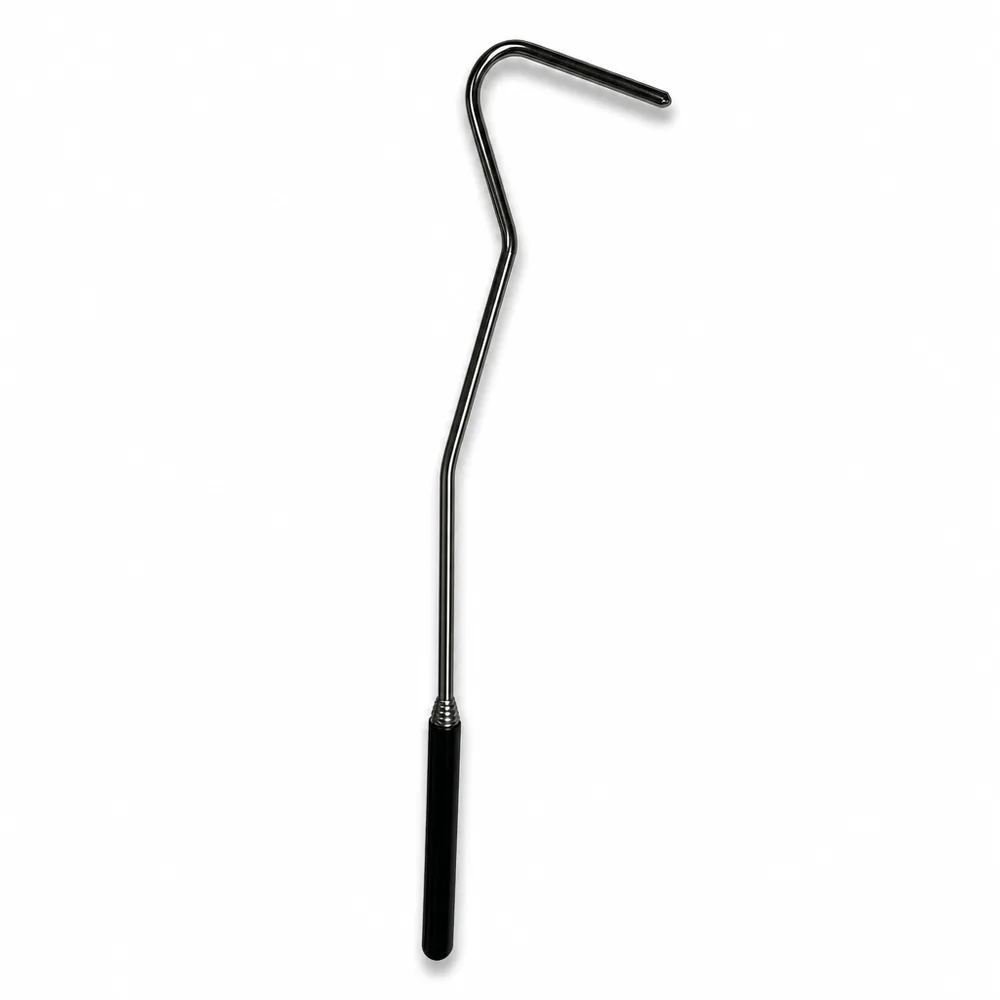
If the animal is confirmed harmless and it will not move on its own, this is the only point in the process where a tool is appropriate. A hook slides under the middle of the body and lets you carry a small snake out at arm's length without gripping it, which is calmer for the animal and safer for you than any improvised container. Our telescopic hook covers hatchlings, colubrids and small snakes, and folding tongs reach the places a hook cannot, behind a water heater or under a workbench. What matters far more than the tool is the rule attached to it: this applies to harmless species only, and never to a snake you have not positively identified. Full method is in the catching guide, and the handling technique is in how to use a snake hook.
When to stop and call someone
Call animal control, your state wildlife agency, or a licensed removal service if the snake is venomous or unidentified, if it is somewhere you cannot isolate, if it is inside the living space of the house, or if anyone in the household is unsteady on their feet or unable to leave the area quickly. That call is free or cheap in most counties, and it is the correct answer far more often than the internet suggests.
The numbers behind that advice are worth knowing. The Centers for Disease Control and Prevention reports 7,000 to 8,000 venomous snakebites in the United States each year, with about 5 deaths (CDC, 2024). Fatalities stay that rare in a country this size precisely because most people leave venomous snakes alone and because antivenom is available in hospitals nationwide.
The more useful figure is where the bites come from. In an analysis of media-reported venomous snakebites in the United States between 2011 and 2013, 32.1% resulted from someone purposefully handling the snake (Curry, Bond, Kunkel et al., Wilderness and Environmental Medicine, 2016). Roughly a third of these injuries happened because a person decided to pick the animal up, catch it, kill it or move it by hand. Almost every one of those was avoidable by walking away.
To be completely clear about our own position: we sell handling tools for keepers and for harmless wild snakes, and nothing we sell makes venomous handling safe for an untrained person. Venomous work is a trained discipline with long tools, protocols and a second person present, and it is regulated in many states. If the snake in your garage is a copperhead, a rattlesnake, a cottonmouth or a coral snake, the correct equipment is a phone.
Making the garage boring again
Once the animal is gone, spend an afternoon removing the reasons it came in. Snakes follow food and shelter, so the work is mostly about rodents and gaps. Fit a door sweep on the garage door, because the gap under a warped panel is the most common entry point in any house. Seal utility penetrations where pipes and cables pass through the wall with steel wool and sealant. Move stacked firewood, feed bags and cardboard away from the walls and off the floor, since a woodpile against a foundation is a rodent hotel with a snake in the lobby.
Outside, cut grass short within a few feet of the building, clear leaf litter from along the foundation, and store birdseed and pet food in sealed containers. Snake repellent granules are worth skipping, because there is no good evidence they work and they mostly buy peace of mind. What reliably works is removing the mice.
Then keep some perspective. A harmless rat snake in a garage is a free rodent control service that has been doing the job for the previous four seasons without you noticing. Getting it out safely, sealing the door and moving on is a better outcome for everyone than the version where somebody grabs a shovel. If you want to know which tools are worth owning before the next one turns up, the hook and tongs comparison is the place to start, and the field checklist covers what to carry outdoors. Questions about a specific situation can go through our contact page, and you can read who we are on the about page.